The tree is Pando, a male quaking aspen clone in Fishlake National Forest. It reaches 106 acres not by growing one colossal trunk, but through asexual reproduction called root suckering: one genetic individual sends up new stems, known as ramets, from an expanding root system. The clone’s estimated mass is about 5.8 million kilograms, roughly 6,000 metric tonnes, and the U.S. Forest Service now describes it as more than 40,000 stems; the familiar estimate of about 47,000 was made before recent mortality.
That distinction matters because a stem count is not a census of separate trees. Utah State University’s current Pando summary lists 106 acres, 13 million pounds and an estimated 47,000 stems before the recent losses, while warning that there is still no reliable way to date the whole clone precisely. The numbers describe one organism wearing the outward form of a forest.
A forest that is biologically one tree
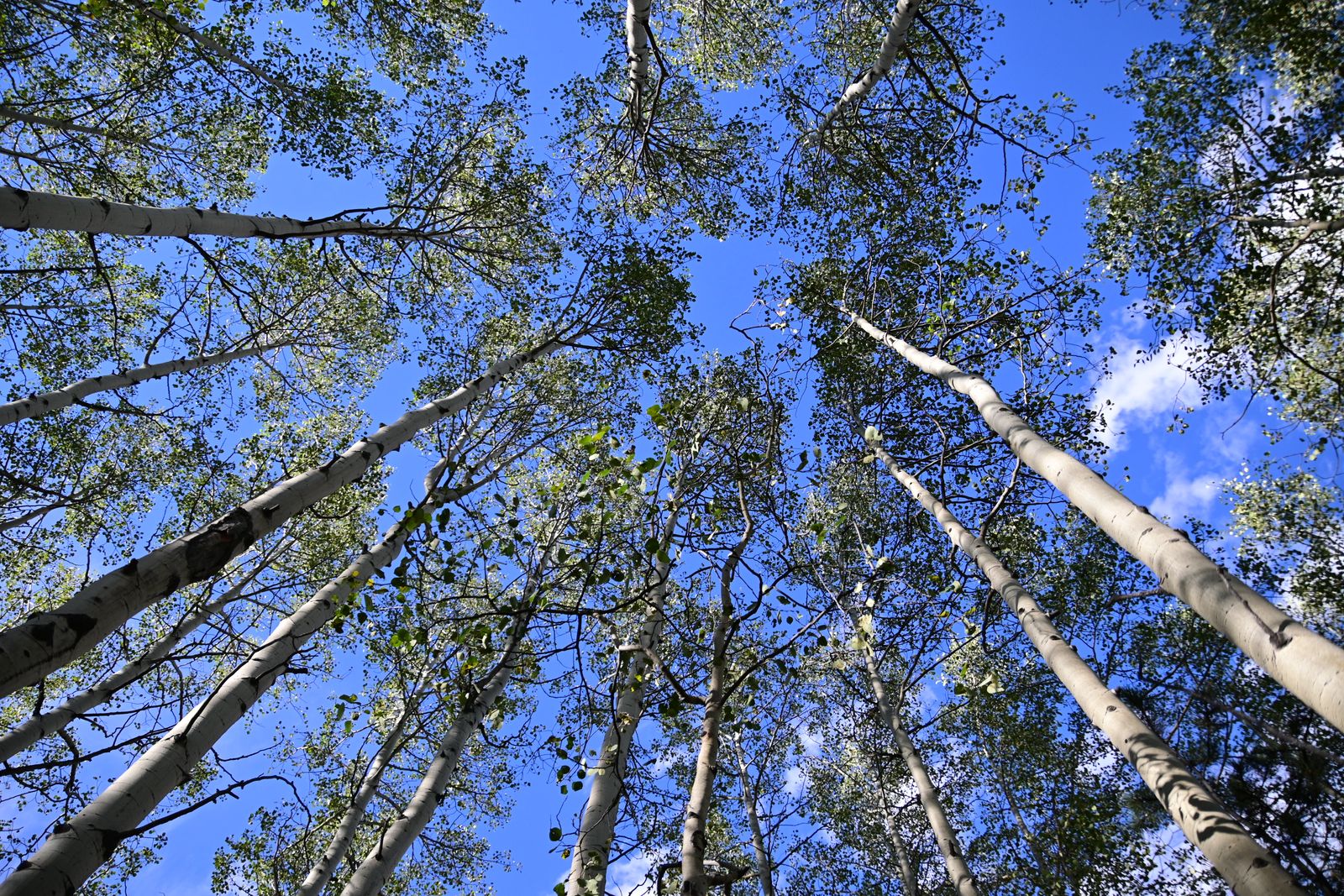
Walk beneath Pando and the classification feels almost perverse. White trunks rise one after another, dark scars mark old branches, and flattened leaf stalks let the crowns flicker in the slightest wind. Sight and sound insist that this is a grove, while the biology says it is one quaking aspen, Populus tremuloides.
The decisive evidence came from genetics. Researchers sampled 209 stems across the suspected clone and found a single genetic entity matching the boundary first mapped from leaf, bark and growth characteristics. Their 2008 molecular study placed that individual across about 43.6 hectares, almost exactly the area now rounded to 106 acres.
A 2026 reviewed preprint based on more than 500 samples detected a mosaic of somatic mutations within Pando, so the familiar phrase genetically identical is useful shorthand rather than literal base-for-base identity. The eLife assessment called the study useful but judged the evidence for several conclusions about the clone’s exact age and the spatial pattern of its mutations incomplete. The safer conclusion is that Pando is one ancient clone whose tissues have accumulated small differences over time.
Pando’s record is therefore different from the record held by a single-stem giant. The National Park Service describes California’s General Sherman as the world’s largest tree by volume, with a trunk weighing nearly 1,400 U.S. tons. Pando’s claim comes from treating tens of thousands of stems and the clonal system that produced them as one living individual.
It is not a flat carpet of identical poles. The clone climbs a southeast-facing mountainside through nearly 100 metres of elevation, from a seasonal floodplain to slopes steeper than 30 percent. Different stems encounter different moisture, sunlight, soil and browsing pressure, even though they descend from the same founding genome.
How one root system makes new trunks
A quaking aspen can reproduce from seed, but Pando’s great expansion happened vegetatively. Buds along lateral roots produce shoots that rise through the soil, unfold leaves and eventually thicken into trunks. The Western Aspen Alliance notes that both above-ground and below-ground tissues turn over rapidly, so one root system is best understood as a living clonal network renewed over time, not the original seedling’s roots preserved intact.
When mature stems die or canopy conditions change, the balance of growth hormones in the clone can release more root buds into growth. Fire, cutting and other disturbances can therefore trigger a flush of suckers, provided the roots retain enough stored energy and the new shoots survive. Pando does not preserve the same trunks forever; it preserves itself by repeatedly replacing them.
The visible stems are young compared with the organism they represent. Tree cores put the oldest living ramets at roughly 120 to 150 years, while the clone itself has probably persisted for millennia. Claims for an exact age should still be treated cautiously because a living root system does not preserve annual rings from its beginning.
This difference between the age of a trunk and the age of the organism appears elsewhere in botany. Multi-stem trees can lose old wood, replace it and continue through the same underlying individual, a complication also explored in Nuclear Power Daily’s account of the wild Wollemi pine’s coppicing trunks. Pando pushes that problem of identity across an entire mountainside.
In July 2022, sound artist Jeff Rice and Friends of Pando founder Lance Oditt used a hydrophone at a below-surface recording location in the clone and picked up faint vibrations. Their later tests found that tapping a branch about 90 feet away produced a low signal at the hydrophone, and stronger wind in the canopy increased the recorded sound. The Acoustical Society of America stressed that the sound was not conclusively proven to come through Pando’s roots, so the experiment is suggestive evidence of connected vibration, not a finished map of the root network.

Why the replacement generation failed
A clone that renews itself through suckers depends on those shoots reaching adulthood. Pando’s mature stems have continued to age and die, but over large unfenced areas too few young ramets have survived to replace them. The result is a demographic gap rather than one sudden, dramatic death.
Paul Rogers and Darren McAvoy tested that gap with ground plots and a 72-year sequence of aerial photographs. Their 2018 PLOS ONE study found declining self-replacement beginning roughly 30 to 40 years earlier and identified mule deer presence as a strong constraint on successful regeneration. The best-performing treatment paired reliable exclusion with active and passive restoration, while an enclosure penetrable by ungulates performed little better than unfenced ground.
The roots have not simply stopped trying. They send up tender shoots rich enough to attract browsing animals, and many are eaten before they rise beyond easy reach. Domestic cattle historically added pressure in parts of the clone, while the research plots pointed most strongly to mule deer as the persistent browser.
That struggle is visible far beyond Fish Lake. In Yellowstone, reduced browsing has allowed some young aspens to rise above the height at which elk can repeatedly clip them, although water, fire history, bison and local terrain also shape the outcome. Nuclear Power Daily’s examination of Yellowstone’s disputed trophic cascade shows why a recovering aspen stand cannot be credited to one cause alone.
Pando also carries ordinary forest ailments on an extraordinary body. Bark beetles, cankers and root disease weaken or kill older stems, while drought can narrow the margin for new growth. Those pressures become more dangerous when browsing has already removed the age classes that should be waiting underneath.
Fencing proved that the clone could still answer disturbance with vigorous growth, but it also divided Pando into sharply different management zones. Some protected sections filled with young stems, while poorly maintained or penetrable barriers allowed browsing to continue. A 2022 remeasurement of 64 plots described the genetically uniform clone as breaking into different ecological trajectories because protection was uneven.
What the fences changed
One early exclosure shows the basic mechanism clearly. After a 1992 cutting treatment, managers fenced roughly 15 acres, and the protected suckers developed into a dense stand now measured at about 20 to 25 feet tall. Nearby shoots without dependable protection were repeatedly browsed back.
Later fencing covered much more ground, but design and maintenance mattered as much as acreage. Ungulates penetrated one enclosure, blurring the difference between fenced and unfenced plots. The lesson from the experiments was practical rather than symbolic: a barrier works only if it consistently excludes the animals that eat the replacement stems.
The status changed again in 2024 and 2025. According to the land-management timeline maintained by Friends of Pando, a $250,000 Utah allocation supported expanded protection, and the completed Pando Protection Plan then brought about 80 percent of the clone’s landmass into protective care. The plan also supplied movable fencing for two additional acres at a time.
Protection is not the same as recovery. Managers still have to track deer movement, repair breaches, measure which suckers escape browse height and decide where disturbance treatments are useful. The oldest stems can fall faster than a newly protected shoot can become part of the next canopy.
What Pando is doing now
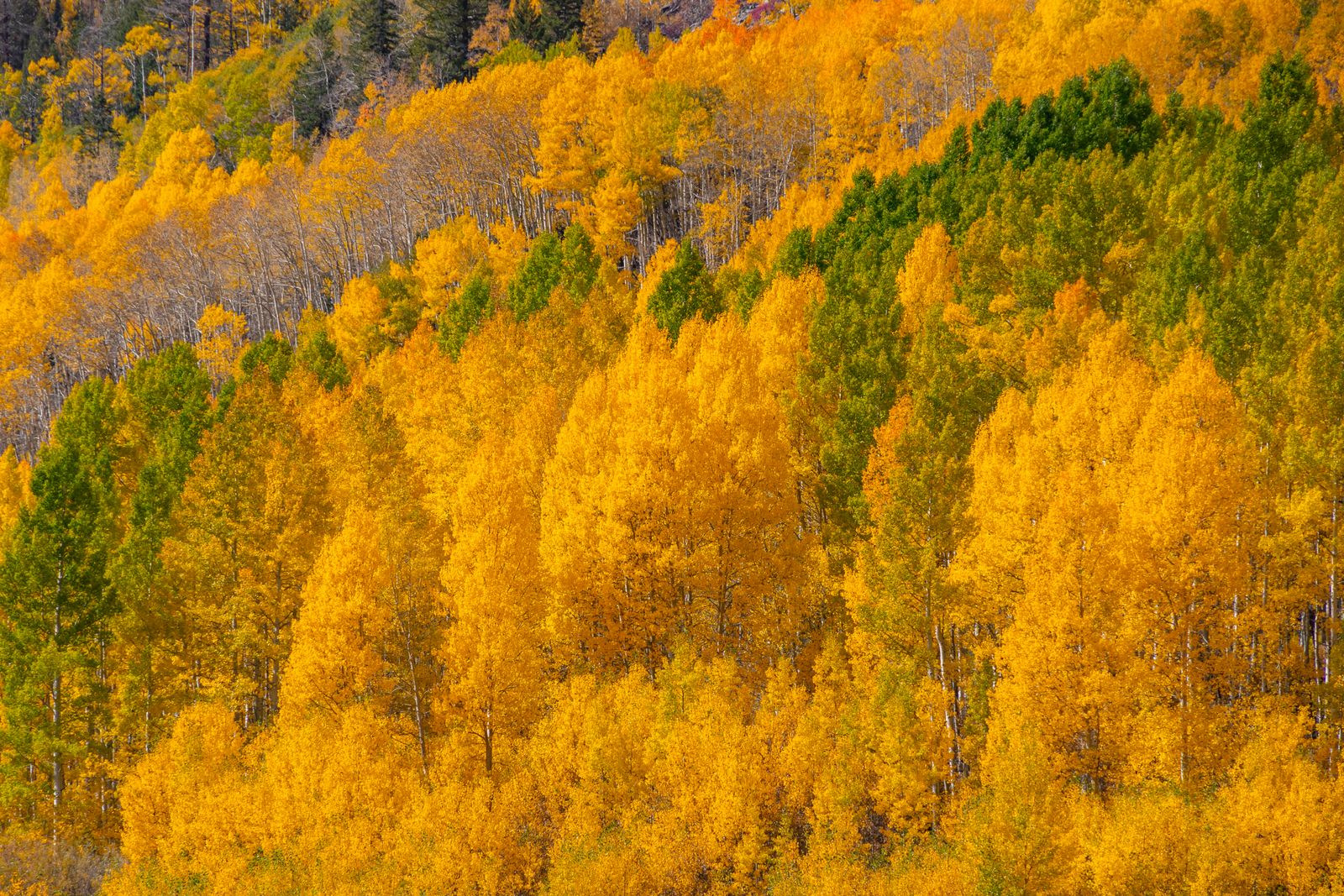
Pando stands about a mile southwest of Fish Lake along Utah State Route 25, across elevations of roughly 2,700 to 2,790 metres, or about 8,900 to 9,150 feet. In late July its normal seasonal face is green rather than gold, with round leaves turning on flattened stalks and flashing pale undersides through the canopy. The autumn spectacle is typically still weeks away.
The area is roughly equal to 80 American football fields including their end zones. Yet scale is easiest to grasp at ground level, where a hiker can pass trunk after trunk while remaining inside one genetic individual. The boundary is immense because the organism has moved sideways by making wood above roots that were already moving through the soil.
Below the leaf litter, new suckers are still emerging. Inside effective protection, some can grow beyond browsing height and begin filling the missing generation; outside it, many can disappear into a deer’s mouth before they become knee-high. Pando’s immediate future is being decided in that small vertical distance.
The tree has survived by exchanging old stems for new ones over a span no human observer can measure directly. At the end of each summer, leaves still tremble across the slope while the hidden system tests thousands of possible beginnings beneath them. Whether enough of those beginnings become trunks will determine how much of the 106-acre organism remains standing when today’s oldest ramets are gone.