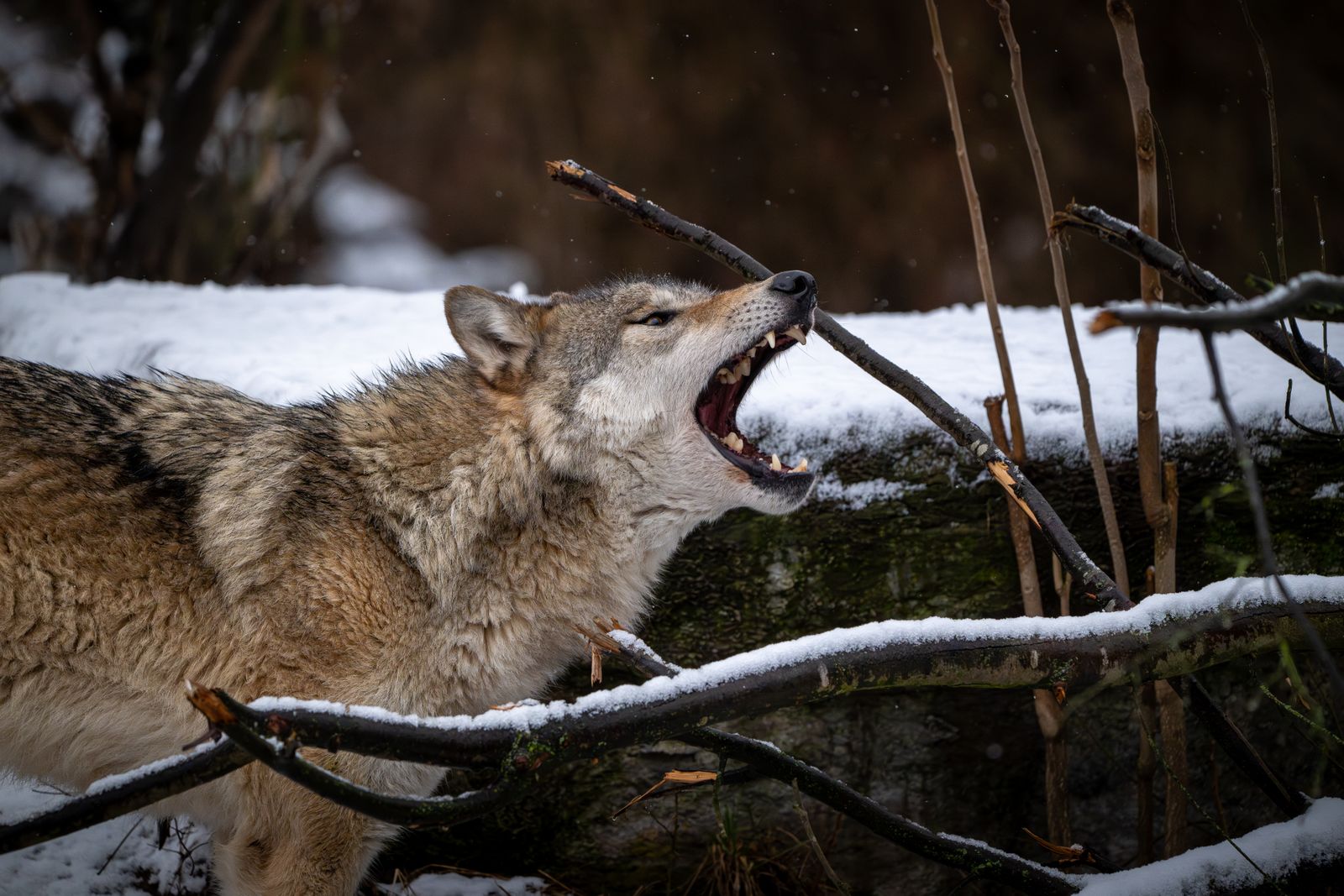
Yellowstone National Park’s wolf restoration began with fourteen Canadian gray wolves brought into the park in January 1995, held in acclimation pens for about ten weeks, and released in March. Twenty-seven more wolves followed through 1997, and by January 2026 the park held at least 84 wolves in eight packs. Their return restored an apex predator, altered the elk-centered food web, and contributed to strong but uneven recovery in some willow and aspen stands. What the evidence does not show is that those first fourteen wolves, by themselves, rerouted Yellowstone’s rivers.
The better answer is more interesting than the viral version. Wolves helped reduce browsing pressure and changed ecological relationships that had been missing for almost seventy years, while hunting, drought, other predators, bison, groundwater, floods, and beavers acted at the same time. Some small streams have begun recovering in ways that are consistent with a trophic cascade, but a local creek rebuilding its banks is not the same thing as a major river changing course because wolves returned.
Fourteen wolves, three pens and a delayed release
When Yellowstone was created in 1872, wolves still occupied the region. Early park managers treated predators as threats to elk, deer, and other animals visitors wanted to see, and federal eradication campaigns used guns, traps, and poison. According to the National Park Service’s history of wolf management, at least 136 wolves were killed inside the park between 1914 and 1926, when the last known pack was eliminated.
The restoration did not begin with crate doors opening onto the Lamar Valley on January 12, 1995. Eight wolves arrived that day and six more arrived on January 19, but biologists placed the three social groups in separate one-acre pens at Crystal Creek, Rose Creek, and Soda Butte. The aim was a soft release: enough time for the animals to settle around the pens and reduce the chance that they would immediately try to travel hundreds of miles back toward Canada.
The Yellowstone Wolf Project’s original 1995-96 report records the sequence precisely. Pen gates were opened on March 21, March 22, and March 27, and the wolves left between March 24 and March 31. By then each animal wore a radio collar, giving researchers an unusually detailed view of how a newly restored large predator explored territory, formed packs, reproduced, and died.
Those fourteen were the opening cohort, not the entire founding population. Seventeen more Canadian wolves were brought to Yellowstone in 1996, followed by ten wolves from northwestern Montana in 1997, making 41 released animals in all. Births, deaths, immigration, and dispersal then connected the park’s packs to wolves across the wider Greater Yellowstone Ecosystem.
The first cascade ran through elk
Elk were the central link because they were both the wolves’ main early prey and the dominant browsers on the northern range. Wolf kills also supplied carcasses to ravens, eagles, bears, coyotes, beetles, and other scavengers, while direct aggression from wolves reduced coyote numbers in some territories. Restoring one predator therefore changed more than the number of elk it killed.
The scale of the elk decline is real, but it is easy to misuse. A record 19,045 northern Yellowstone elk were counted in January 1994, while a March 2024 helicopter survey observed 5,597 animals in the herd’s wintering area. Those figures are not a clean laboratory-style before-and-after comparison because aerial counts miss animals, methods and sighting conditions vary, and most of the herd now winters outside the park.
Wolves were one cause of the decline, not its sole cause. The Park Service’s review of northern Yellowstone elk dynamics describes overlapping pressure from human hunting beyond the boundary, severe winters, drought, recovering cougar and grizzly populations, and predation on calves. In the first decade after restoration, the agency says hunting, winter severity, and drought generally outweighed wolves as population drivers.
The predator-prey system has kept changing. Elk once dominated the wolves’ winter diet, while the much larger bison population now supplies more food through both scavenging and occasional predation. Grizzly bears and cougars have recovered too, so an elk moving through the northern range encounters a full community of large predators rather than a landscape controlled by one returned species.
As of January 2026, the Park Service counted at least 84 wolves in eight packs. The population rises and falls with births, disease, territorial fights, prey, dispersal, and deaths outside the park. Yellowstone does not manage toward a fixed wolf number; it monitors whether the population remains healthy and connected.
That monitoring now combines collars, aircraft, direct observation, remote cameras, genetic work, and sound. Each method captures a different part of a population that can cross ridges, forests, roads, and park boundaries in a matter of hours. Together they turn occasional sightings into a long record of movement, kinship, hunting, reproduction, and mortality.
Aspen and willow rose above browse height
The vegetation question begins at an elk’s mouth. For decades, young willow and aspen stems on parts of the northern range were repeatedly bitten back before they could become tall shrubs or trees. Once browsing pressure eased, some stems escaped above the height at which elk could keep clipping the newest growth.
A 2025 study of 87 northern-range aspen stands found a striking change from surveys in the 1990s. Roughly one-third of the stands contained large numbers of tall saplings throughout, evidence of a new overstory generation after decades of failed recruitment. That is a substantial recovery signal, but it is not an ecosystem-wide return to some fixed historical state.
Another third of the sampled stands had tall saplings only in patches, while the rest remained heavily browsed or lacked strong recruitment. Local moisture, snow, fire history, soil, bison use, and the position of each stand all matter. A wolf can affect the odds that an elk reaches a young tree, but it cannot create groundwater beneath a dry terrace or prevent a bison from eating the same shoots.
The Park Service therefore describes the trophic cascade as real enough to investigate and too complex to reduce to a slogan. Its overview of Yellowstone’s ecological processes says most researchers agree wolves contributed to fewer elk and changes in elk behavior. It also notes continued disagreement over how much plant growth came from predation, fear, groundwater, warming, precipitation, and other forces.
That disagreement sharpened again in 2025. One analysis of long-term willow measurements concluded that crown volume had risen dramatically at 25 riparian sites and characterized the cascade as unusually strong. Its authors argued that two decades of monitoring captured a slow recovery that shorter studies had missed.
A subsequent peer-reviewed comment challenged the calculation, the matching of sampling plots, and the way human hunting was treated. The critics did not argue that nothing changed; they argued that the strength and geographic reach of the change had been overstated. The live scientific dispute is now less about whether wolves mattered than about how much credit they deserve, where, and through which mechanism.
Beavers returned, but dams are not the same as rivers
Beaver numbers provide another tempting before-and-after story. Park-wide aerial surveys counted 49 colonies in 1996, reached 127 in 2007, and estimated 121 in 2024, according to the Park Service’s beaver record. Yet observers became better at finding colonies, annual counts have fluctuated widely, and 129 beavers were also released into drainages north of the park between 1986 and 1999, creating another route for recolonization.
Beavers can transform water locally. Their dams slow shallow streams, trap sediment, spread water across valley bottoms, and raise nearby water tables, which can favor more willow and wetland habitat. The mechanism resembles the small canal barriers used to rewet drained peatlands in Indonesia, although beavers build opportunistically rather than from an engineering plan. Yellowstone’s own survey also notes that most beaver dams occur on small, low-gradient streams; colonies on major rivers such as the Lamar commonly live in bank dens instead of damming the channel.
There is direct evidence that at least some small streams changed after carnivores returned. A 2019 study of two forks of Blacktail Deer Creek found that willows held mostly below 52 centimeters during the high-browsing period had grown into tall stands by 2017. The researchers also documented denser bank vegetation, greater overhead cover, and the beginning of an inset floodplain, all consistent with a creek recovering as herbivory declined.
That study matters because it links vegetation to channel form rather than stopping at taller shrubs. Roots can bind soil, stems can slow overbank water, and trapped sediment can gradually rebuild a narrow floodplain. It supports the possibility that carnivore recovery, acting with other predators and environmental conditions, indirectly changed selected stream reaches.
It does not establish that wolves shifted the course of Yellowstone’s major rivers across the park. River channels respond to discharge, gradient, sediment, bank material, snowmelt, groundwater, ice, floods, and the volcanic and glacial terrain beneath them. A direct engineered intervention such as the eight-mile Kok-Aral Dam that revived part of the Aral Sea can be isolated and measured; Yellowstone’s food web offers no comparable single switch.
The defensible verdict is therefore specific. Wolves helped create conditions in which vegetation and beavers could alter some small streams, stabilize some banks, and rebuild some floodplains. The popular statement that fourteen wolves made Yellowstone’s rivers change course compresses a plausible local mechanism into a park-wide causal claim that the evidence does not support.
What thirty-one years of Yellowstone can prove
Yellowstone is often described as a natural experiment, but it had no untouched control park sitting beside it. Wolves returned while hunting policies changed, drought persisted, winters varied, bears and cougars recovered, bison increased, post-fire forests continued to mature, and climate continued to shift. Researchers can compare plots, years, watersheds, and animal movements, but they cannot rewind the northern range and rerun it without wolves.
What happened after the release is still extraordinary. A breeding wolf population re-established itself at the core of a much larger connected population, elk faced a restored guild of predators, scavengers gained a more regular supply of carcasses, and parts of the northern range produced tall willow and a new generation of aspen. Beaver colonies expanded, and at least a few creeks show physical recovery consistent with reduced browsing and stronger riparian growth.
Ecologists keep arguing because each link in the chain operates at a different scale. A wolf kills an individual elk; thousands of elk affect browsing across years; groundwater determines whether a willow can respond; beavers reshape certain low-gradient streams; floods can erase or rebuild channels in hours. Evidence that is convincing at one creek or stand becomes much weaker when stretched across 2.2 million acres.
In winter, a wolf may still appear as a dark fleck moving beyond a mile of pale sage, visible only through a spotting scope. The science has the same problem of scale: one carcass, one aspen stand, one recovering creek, and then the temptation to make that fragment speak for an entire national park. Yellowstone’s wolves returned in a handful of crates, but the landscape they entered was never simple enough to obey a single line of cause and effect.