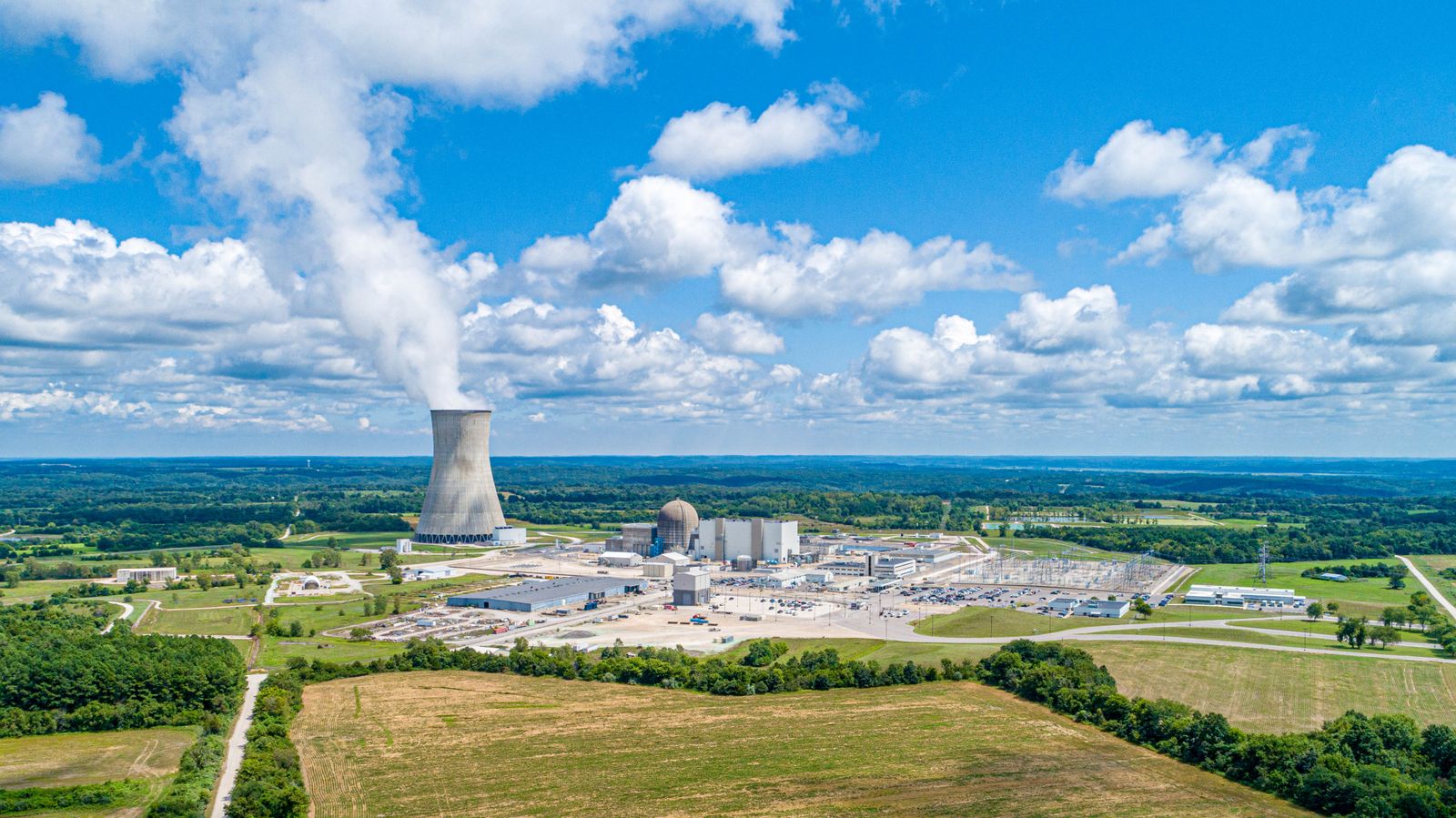
A CANDU reactor pulls its fuel straight from a Saskatchewan mine, presses it into ceramic pellets, stacks the pellets into zirconium tubes, and burns them without ever sending a gram of uranium through a centrifuge. The trick sits in the coolant. Every water molecule circulating through the core carries deuterium instead of ordinary hydrogen — a heavier isotope with an extra neutron in its nucleus — and that single subatomic passenger changes the physics enough that natural uranium, 0.7 percent fissile U-235, will sustain a chain reaction on its own.
The rest of the nuclear world had to build an entire industrial complex to avoid this problem. Enrichment plants the size of small cities, cascades of centrifuges spinning at the edge of material tolerance, decades of export controls and diplomatic anxiety. Canada looked at the same physics and picked a different variable to change. Instead of concentrating the fuel, engineers at Atomic Energy of Canada Limited concentrated the moderator.
What the extra neutron does
Ordinary water is H₂O. Heavy water is D₂O, where each hydrogen atom has been swapped for deuterium — one proton, one neutron, still chemically hydrogen but roughly twice the mass. The molecule ends up about 10 percent denser than regular water, which is why Canadian Nuclear Laboratories and its partners still refine the stuff drop by drop for reactors and, increasingly, for semiconductor and life-sciences buyers.
Deuterium occurs naturally. Roughly one in every 6,400 hydrogen atoms in seawater is already deuterium. Separating it out is tedious rather than exotic — the historical Girdler sulfide process cycled water and hydrogen sulfide gas through hundreds of stages at different temperatures to slowly concentrate the isotope. The result is a clear liquid indistinguishable to the eye from tap water, dense enough that an ice cube of heavy water sinks in a glass of ordinary water.
Inside a reactor, the moderator has one job: slow neutrons down. Fresh fission neutrons come screaming out of a splitting U-235 nucleus at a few million electron volts. To make them likely to split another uranium nucleus rather than fly off or get absorbed, they need to lose almost all of that energy and settle into the thermal range, a few hundredths of an electron volt. They lose it by bouncing off small nuclei.
Why light water forces you to enrich
Ordinary hydrogen is superb at slowing neutrons. A neutron and a proton have almost identical mass, so a head-on collision transfers nearly all the neutron’s energy in a single bounce, the way a cue ball stops dead when it strikes a stationary billiard ball. The problem is that ordinary hydrogen also likes to eat neutrons. A proton will occasionally grab a passing neutron and become deuterium, releasing a gamma ray and taking that neutron permanently out of the chain.
That parasitic absorption is small per collision but relentless. In a light-water reactor, enough neutrons vanish into hydrogen that natural uranium simply cannot keep the reaction going. The fuel has to be enriched — the U-235 fraction pushed from 0.7 percent up to somewhere between 3.5 and 5 percent — to compensate for the neutrons the moderator is stealing.
Deuterium already has the neutron. It is far less inclined to grab another. Its absorption cross-section is roughly a thousand times smaller than ordinary hydrogen’s. The tradeoff is that a deuterium nucleus is twice as heavy as a proton, so each collision sheds less energy and a neutron needs more bounces to thermalise. You end up with a bigger, slower moderator region, but almost no neutrons are lost along the way. The margin that light water burns through with enrichment, heavy water banks by not absorbing anything.
Fermi’s pile, and the fork in the road
The choice was never inevitable. When Enrico Fermi’s team assembled Chicago Pile-1 under the west stands of Stagg Field in December 1942, they used graphite bricks as the moderator, stacked between slugs of natural uranium. Carbon-12 is heavier than deuterium and less efficient per collision, but graphite was available in tonnage quantities and the physics worked well enough to hold the first self-sustaining chain reaction steady for 28 minutes.
Graphite let the Manhattan Project produce plutonium at Hanford without waiting for enrichment. Heavy water was the other path. Norwegian production at Vemork became a strategic target for Allied sabotage precisely because a heavy-water moderator plus natural uranium was a plausible route to a weapon. After the war, three broad choices sat on the table for anyone building a civilian reactor: enrich the uranium and use ordinary water, use graphite and take the risks of a large flammable moderator block, or invest in heavy water and burn cheap fuel forever.
The United States and the Soviet Union both had enrichment plants left over from weapons work and pushed light-water and graphite-moderated designs into the civilian sector. The first grid-connected reactor at Obninsk in 1954 used graphite and slightly enriched fuel. Canada, with vast uranium ore reserves and no enrichment infrastructure, went the other way.
The CANDU bargain
CANDU stands for Canada Deuterium Uranium, and the acronym is also a specification. The reactor is a horizontal pressure-tube design: hundreds of zirconium-alloy tubes run through a large tank called a calandria, which is filled with cool, low-pressure heavy water acting as the moderator. Inside each tube, a second, pressurised stream of heavy water flows past the fuel bundles at around 300 degrees Celsius, carrying heat out to the steam generators. The moderator and the coolant are the same substance but perform different jobs at different temperatures and pressures.
The fuel is uranium dioxide pressed into ceramic pellets and loaded into short bundles roughly the size of a fireplace log. Because the fuel is natural uranium, individual bundles hold far less fissile material than an enriched light-water assembly, and they burn out faster. CANDUs are refuelled on-line, one channel at a time, by robotic fuelling machines that clamp onto both ends of a pressure tube and push fresh bundles in while spent ones exit.
The economics cut in an unusual direction. Fuel is cheap because there is no enrichment bill, but the initial heavy-water inventory is expensive — a large CANDU needs several hundred tonnes of D₂O, and the stuff is priced somewhere around 300 to 500 US dollars per kilogram depending on purity. The reactor produces more spent fuel per unit of electricity than a light-water plant, because each uranium atom releases less energy before the bundle has to come out. What Canada saved on centrifuges, it spent on isotope separation columns and on a bigger back-end waste footprint.
What heavy water is worth in 2026
The industrial base for D₂O has narrowed. Canada’s dedicated heavy-water plants at Bruce and Glace Bay were shut down decades ago once existing CANDU inventories were topped up. Today the material comes from a handful of operators worldwide, and Canadian Nuclear Laboratories signed a strategic partnership with Isowater Corporation to refine deuterium for both nuclear and non-nuclear buyers, citing more than 10 percent annual growth in demand from electronics, OLED display manufacturing, fibre optics, and pharmaceutical research.
American national laboratories have felt the pinch. Oak Ridge’s Spallation Neutron Source needed D₂O for its second target moderator system and, in a strange bit of geopolitical arithmetic, the Department of Energy purchased 32 metric tons of heavy water from Iran in 2016 under the Joint Comprehensive Plan of Action. The material was shipped to Oak Ridge and resold to researchers and industry, an odd afterlife for a substance that a decade earlier had been treated primarily as a proliferation concern.
The Iranian purchase produced an image most people never associate with reactor physics: stainless-steel drums of D₂O unloaded at Oak Ridge, each one indistinguishable from a barrel of any other liquid, together holding enough moderator to run a small research reactor for years.
The proliferation ledger
The CANDU design has always carried a footnote. A reactor that runs on natural uranium and refuels on-line is exceptionally good at producing weapons-usable plutonium, because individual fuel bundles can be pulled out before their plutonium content becomes too contaminated with heavier isotopes. India’s first nuclear device, detonated in 1974 and euphemistically labelled a peaceful nuclear explosion, was built with plutonium bred in the CIRUS research reactor, a heavy-water design supplied by Canada in the 1950s under a research cooperation agreement.
Every subsequent CANDU export came with tighter safeguards. The design’s fuel flexibility, though, remains one of its selling points on the civilian side. Because the neutron economy is so generous, CANDUs can burn things light-water reactors struggle with: recycled uranium recovered from spent light-water fuel, mixed thorium-uranium blends, and low-enriched fuels tailored to reduce waste output. Clean Core Thorium Energy recently completed a two-year test of an experimental thorium-based fuel called ANEEL aimed specifically at pressurised heavy-water reactors, reporting reduced long-lived waste and higher burnup than natural uranium bundles.
That fuel flexibility echoes an older experiment. In the late 1970s, engineers at the Shippingport reactor ran a thorium-uranium-233 core that produced slightly more fissile material than it consumed, demonstrating breeding in a water-moderated system. CANDU’s neutron budget makes the same trick easier.
Where the CANDU fleet stands now
Roughly 30 CANDU or CANDU-derivative reactors are operating today, in Canada, South Korea, Romania, China, Argentina, India and Pakistan. Ontario Power Generation runs the eight-unit Pickering station and the four-unit Darlington station, both on the north shore of Lake Ontario, plus the eight units at Bruce operated by Bruce Power. Pickering’s older units were the subject of a 2021 campaign by the Ontario Clean Air Alliance, which called for a moratorium on continued operation, citing the CANDU design’s positive coolant void coefficient and the age of the plant.
The Darlington refurbishment, meanwhile, is the largest nuclear project underway in North America, with each of the four reactors being taken offline in sequence, gutted, and rebuilt with new pressure tubes, calandria tubes, feeders and steam-generator internals. The heavy water is drained, purified, and re-injected once the refurbished channels are ready. Each refurbished unit is expected to run for another 30 years, which means CANDUs commissioned in the 1980s and 1990s will still be splitting natural uranium into the 2060s.
The physics never went away
Enrichment technology has moved on. Gas centrifuges have largely replaced the older gaseous-diffusion cascades, and laser enrichment — separating isotopes by tuning a laser to the specific absorption line of U-235 — is finally moving out of the lab. A recent MIT Technology Review report describes how laser-based enrichment could reshape reactor fuel supply, potentially producing enriched uranium at lower cost and smaller footprint than centrifuges. Some of the same techniques could, in principle, be used to separate deuterium as well.
Even so, the underlying arithmetic that led Canadian engineers into heavy water in the 1950s has not changed. A U-235 fission still releases about 200 million electron volts, natural uranium still contains 0.7 percent of it, and the moderator you choose still determines whether that concentration is enough. Substitute deuterium for hydrogen, tolerate the extra plumbing, and you skip the centrifuge.
The scale of what that choice avoided is easy to miss. The United States built the Oak Ridge, Paducah and Portsmouth gaseous-diffusion plants, at one point consuming a measurable fraction of national electricity output. Urenco runs enrichment complexes across three European countries. Rosatom operates four sites in Russia. Canada has none, has never needed any, and still exports uranium ore by the tonne to countries that will pay to concentrate what CANDUs are perfectly happy to burn as it comes out of the ground.
The heavy water in a CANDU calandria is doing something quiet and continuous. Every microsecond, fission neutrons stream out of the fuel channels into the surrounding moderator, bounce off deuterium nuclei a couple of dozen times each, shed their energy, and drift back into the fuel as thermal neutrons ready to split the next U-235 atom. That extra neutron on each hydrogen — the one that makes the water 10 percent heavier and sinks the ice cube — is what keeps the whole thing going without a centrifuge anywhere in the picture.