
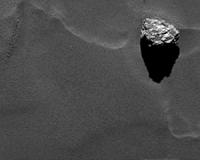
The European Space Agency (ESA) has posted new and impressive images of the comet 67P/Churyumov-Gerasimenko on the Rosetta blog. The images were returned by ESA's Rosetta spacecraft, which arrived at the comet on August 6, 2014, after a more than 10-year journey.
One of the images shows a closeup of a boulder dubbed Cheops (a name inspired by the Great Pyramid of Egypt), which is one of the largest boulders seen on the comet so far.
Scientists began documenting the many boulders scattered across the surface of 67P/Churyumov-Gerasimenko after Rosetta's arrival in order to select a safe landing site for the Philae lander. Philea will be released from Rosetta on the 12th of November, 2014.
A primary landing site (dubbed 'Site J') has been selected, and ESA is scheduled to make a final confirmation of Philae's landing scenario on October 14th.
Rosetta's Philae lander will be the first spacecraft to attempt a soft-landing on a comet nucleus. If successful, it will also become the first mission to transmit data from a comet's surface. The lander will collect data with its payload of ten instruments.
Data from Philae will help astrobiologists understand the composition of comets. Some theories suggest that these objects from space delivered materials essential for the origins of life to the early Earth.
