
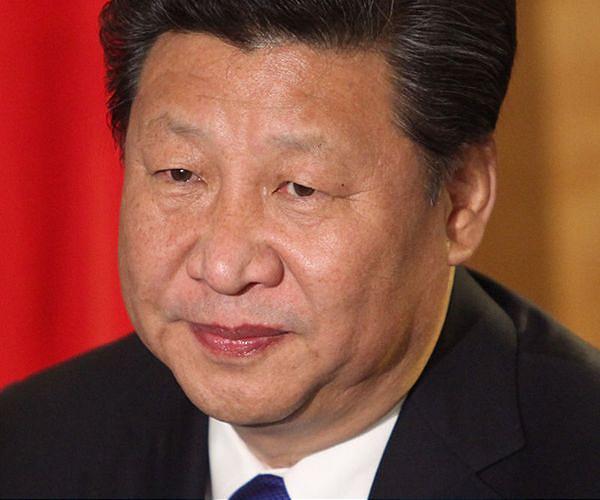
President Xi Jinping hailed China's "irreversible" course from colonial humiliation to great-power status at the centenary celebrations for the Chinese Communist Party on Thursday, in a speech reaching deep into history to remind patriots at home and rivals abroad of his nation's — and his own — ascendancy.
Speaking above the giant portrait of Mao Zedong which dominates Tiananmen Square, from the podium where the famous chairman proclaimed the People's Republic of China in 1949, Xi said the "era of China being bullied is gone forever" praising the party for raising incomes and restoring national pride.
Drawing a line from the subjugation of the Opium Wars to the struggle to establish a socialist revolution in China, Xi said the party had brought about "national rejuvenation" lifting tens of millions from poverty and "altered the landscape of world development".
Xi, wearing a Mao-style jacket, added the "great rejuvenation of the Chinese nation has entered an irreversible historical course" and vowed to continue to build a "world-class" military to defend national interests.
In the summer of 1921 Mao and a clutch of Marxist-Leninist thinkers in Shanghai founded the party which has since morphed into one of the world's most powerful political organisations.
It now counts around 95 million members, garnered over a century of war, famine and turmoil, and more recently a surge to superpower status butting up against Western rivals, led by the US.
In a ceremony of pomp and patriotism, thousands of singers, backed by a marching band, belted out stirring choruses including "We Are the Heirs of Communism" and "Without the Communist Party there would be no New China" as maskless invitees cheered and waved flags in a packed Tiananmen Square.
A fly-by of helicopters in formation spelling '100' — a giant hammer and sickle flag trailing — and a 100-gun salute followed, while young communists in unison pledged allegiance to the party.
– Power, popularity and purges –
Xi, whose speech braided the economic miracle of China with the longevity of the party, has cemented his eight-year rule through a personality cult, ending presidential term limits and declining to anoint a successor.
He has purged rivals and crushed dissent — from Uyghur Muslims and online critics to pro-democracy protests on Hong Kong's streets.
The party has pivoted to new challenges; using tech to renew its appeal to younger generations — 12.55 million members are now aged 30 or younger — while giving a communist finish to a consumer economy decorated by billionaire entrepreneurs.
On Beijing's streets, praise for the party was effusive from those willing to speak to foreign media.
"We should thank the party and the motherland," said Li Luhao, 19, a student at Beihang University performing in the celebration.
A man surnamed Wang, 42, said: "When I was a child there was a blackout for one hour every night and electricity shortages."
"Now the streets are full of light. Food, clothes, education, traffic are all better."
While the president did not mention himself in the speech, "it is quite clear that much of the credit for China's success belongs to Xi," said Willie Lam, China analyst at the Chinese University of Hong Kong.
Xi has presented a defiant face to overseas rivals, revving up nationalist sentiment. He has batted back criticism of his government's actions in Hong Kong, attitude towards Taiwan and treatment of the Uyghurs.
"The Chinese people will never allow any foreign forces to bully, oppress, or enslave us," Xi said in his speech, to great applause.
"Whoever wants to do so will face bloodshed in front of a Great Wall of steel built by more than 1.4 billion Chinese people."
– Party time? –
In its 100th year, the party has delivered a selective version of history through films, 'red tourism' campaigns and books, which dance over the mass violence of the Cultural Revolution, famines and the Tiananmen Square crackdown.
Instead, it has drawn attention to China's rebound from Covid-19, which first emerged in the central city of Wuhan but has been virtually extinguished inside the country.
But reminders linger of the risks to stability.
Thursday also marks the 24th anniversary of Hong Kong's return to Chinese rule — a date once met with mass demonstrations against Beijing inside the former British colony.
One year ago, China imposed a draconian national security law on the city in response to huge, often violent, pro-democracy protests.
The measure has seen activists charged, anti-China slogans criminalised and even the closure of a critical newspaper as the law sinks the once freewheeling city into what Amnesty International calls a "human rights emergency".
Four activists marched with a banner near the official anniversary reception on Thursday — tailed by 200 police officers, a fraction of the thousands deployed across the city to deter pro-democracy groups from mobilising.
"The CCP can go to hell," a Hong Konger who gave his name only as Ken told AFP.
"Anything that's worthwhile, they destroy."
Secret society: What the Chinese Communist Party doesn't want you to know
Beijing (AFP) July 1, 2021 – China's ruling Communist Party, which celebrates its 100th anniversary Thursday, is characterised by secrecy in leading the world's second-biggest economic power from the shadows.
Founded as an illegal Marxist underground movement in Shanghai a century ago, it has subsequently been defined by the strict control of information, surveillance and purges of dissenters.
Here are five things the CCP does not like people to discuss:
Who are the members?
The party claims 95.1 million members, but a complete list of names is not made public.
It is far from straightforward to sign up, with a rigorous two-year application process that relies on candidates having a spotless personal history.
It is the second-largest political party in the world, after the BJP under Indian Prime Minister Narendra Modi, which claims 180 million members.
From the latest figures released by the CCP's Organisation Department, only 6.5 million members are labourers and 25.8 million are agricultural workers — compared with a majority of 41 million white-collar professionals and 19 million retired cadres.
"At the highest-level conferences of party representatives, we can see that it is purely a political party made up of the bureaucrat class," said Beijing-based political analyst Wu Qiang.
How is it funded?
The CCP's budget is not made public, while the personal wealth of its leaders is an extremely sensitive topic.
CCP members contribute up to two per cent of their income to party coffers. In 2016, an official journal reported that the total amount of contributions for the previous year was 7.08 billion yuan ($1 billion).
But contributions are only a small part of its income. The party is at the head of a financial empire and directly manages companies, hotels and factories, said Jean-Pierre Cabestan of Hong Kong Baptist University.
Meanwhile the salaries — and perks — of its leaders remain a black box.
Several foreign media outlets have suffered retribution for reporting on huge and illicit fortunes made by China's leaders and their families through lucrative investments, often stashed in tax havens or complicated financial structures with obscured ownership.
A 2012 Bloomberg investigation estimated President Xi Jinping's close relatives owned assets worth billions of yuan.
How many victims?
Most foreign scholars of Chinese history estimate that between 40 and 70 million people in China have died as a result of the party's policies since it came to power in 1949.
These include numerous internal purges, the Great Leap Forward — Mao Zedong's disastrous economic policy which led to tens of millions dying from starvation — repression in Tibet, the decade-long Cultural Revolution and the 1989 Tiananmen Square crackdown.
China has repeatedly faced accusations of forced organ harvesting from prisoners, and in particular members of the banned Falun Gong spiritual movement — accusations Beijing has always forcefully denied.
Human rights groups say an estimated one million Uyghurs and other minorities in Xinjiang have been rounded up into internment camps — which Beijing says is to eradicate Islamic extremism — alongside claims of imposed sterilisation and forced labour.
Who are its opponents?
Hundreds of thousands of activists, lawyers and rights advocates have been detained or arrested over the years.
Under Xi, the space for civil society has tightened. More than one million officials have been punished under his crackdown on corruption, though critics say the campaign has also served as a cover to purge political rivals.
A 2015 crackdown rounded up hundreds of lawyers and human rights activists while, in Hong Kong, dozens have been charged under a sweeping national security law that criminalises anything deemed subversion.
The party does boast genuine support — including from those who have benefited from the country's recent economic boom and groups of young nationalists — but tight control over media also whittles out reports that hint at criticism and controls online discussions.
Secret meetings
CCP meetings include a five-yearly congress, which usually ends with the near-unanimous adoption of decisions.
High-level meetings of the 200-strong Central Committee take place behind closed doors, as do those of the Political Bureau, the inner cabinet.
State television usually broadcasts an officially approved readout later.
The debates, if there are any, are not made public.
"Hiding internal tensions allows the CCP to present a steel facade to its enemies and those of China," Cabestan explained.
Its closed-door nature makes it "the largest secret society in the world", he said.
