
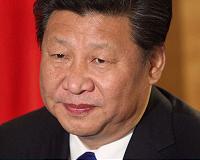
China's President Xi Jinping on Friday called for a "fair and friendly" environment for Chinese companies and citizens overseas, as pushback against its tech giants rises and academics find their visas cancelled.
Beijing and Washington have been locked in a bruising trade war — which negotiators have been working to resolve — but there has also been a growing strategic rivalry between the world's two largest economies.
"China's measures to expand opening up are independent choices," Xi told a gathering of 37 world leaders at a summit for his signature Belt and Road Initiative.
"We also hope that all countries in the world will create a good investment environment, treat Chinese enterprises, international students and scholars equally, and provide a fair and friendly environment," he said.
An increasing number of Western countries have moved to block Huawei and its state-backed competitor ZTE from building next-generation 5G networks over fears Beijing could spy on communications and gain access to critical infrastructure.
The United States has also started to bar some Chinese academics from the country if they are suspected of having links to Chinese intelligence agencies, the New York Times reported.
It added that thirty Chinese scholars have had their visas cancelled or put under review in the past year.
In accounts published in the state-run Global Times, several Chinese academics said their 10-year visas to the US were cancelled, with officials citing concerns over their links to Chinese intelligence.
"Some Chinese were deliberately targeted when visiting the US and had their baggage searched, but cases of cancelling visas are not common," wrote Jin Canrong, dean of international studies at the elite Renmin University.
Such instances were rare even during the Cold War, he added.
Beijing has apparently hit back in retaliation: China expert Michael Pillsbury, who advises US President Donald Trump on China, said his visa to enter the country for a forum earlier this year was blocked.
Tensions flared between Washington and Beijing last December over the arrest of Huawei executive Meng Wanzhou, who is wanted in the US for violating Iranian sanctions.
She was arrested in Canada on request of the US and is now fighting extradition.
China's Belt and Road: Ports, trains and infrastructure
Beijing (AFP) April 26, 2019 –
China is trying to woo more nations to join a massive network of ports, railways, roads and industrial parks that links dozens of countries in Asia, Europe and Africa.
President Xi Jinping touted the benefits of his signature foreign policy, the Belt and Road Initiative, as he welcomed 37 world leaders at a summit dedicate to it on Friday.
Since Xi launched Belt and Road in 2013, China has invested $90 billion in projects while banks have provided upwards of $300 billion in loans.
While participants welcome the chance to improve their countries' infrastructure, experts warn that Belt and Road can saddle nations with new debt and cause environmental harm.
– Which countries have signed on? –
China's foreign minister said last week that 126 countries and 29 international organisations have signed cooperation agreements with Beijing on the Belt and Road.
However, many of those agreements do not amount to full-throated support of the project but rather propose limited cooperation in third-party countries or investment and business cooperation.
Italy became last month the first G7 country to sign up, despite US criticism and suspicion about it among other European Union powers.
– Trains –
The China Railway Express to Europe links 62 Chinese cities with 51 European cities in 15 different countries — freight trains have made 14,691 trips since the route opened in 2011.
The total value of cargo sent back and forth hit $33 billion in 2018, with 94 percent of trains starting in China fully loaded but only 71 percent of those making the return journey full of cargo.
Construction of a 414-kilometre (257-mile) rail line between China and Laos is well underway with investment already hitting 13.13 billion yuan ($1.95 billion) and 12 tunnels already blasted through.
Another rail project in Thailand will link with the Laos line connecting the Chinese border to Thailand's ports. It will transform southwestern Yunnan province into a trading hub that exports China's goods to Southeast Asian markets.
In Africa, a Belt and Road railway has connected Nairobi and Mombasa on the Indian Ocean coast, linking the Kenyan capital with its largest port.
– Roads and ports –
In Pakistan, a controversial trade route was inaugurated to link its southwestern Gwadar port, on the Arabian Sea, with Kashgar, a city in China's northwestern Xinjiang province.
The China-Pakistan Economic Corridor includes a 392-kilometre highway from Peshawar to Karachi scheduled to be completed this year, a new highway, airport and hospital at Gwadar port, among many other projects in the country.
The port will provide China with safer and more direct access to the oil-rich Middle East than the waterway trade route it currently uses through the narrow Malacca Straits.
"Our critical infrastructure gaps are being plugged. Gwadar, once a small fishing village, is transforming rapidly into a commercial hub," Pakistani Prime Minister Imran Khan told the summit.
The economic corridor has alarmed India because it cuts through Gilgit and Baltistan in Pakistan-administered Kashmir — disputed territory that New Delhi claims is illegally occupied.
