
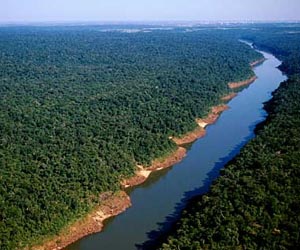
The UN's highest court is set to deliver judgment Tuesday in a dispute between Argentina and Uruguay over a paper mill that Argentina claims pollutes a shared river.
In public hearings before the International Court of Justice last September, Argentina accused its neighbour of having reneged on a treaty when it authorised the construction of a one-billion dollar (740-million-euro) mill on the River Uruguay.
It said the mill was causing "irreversible" environmental damage in a densely populated area whose inhabitants use the river for fishing, leisure and tourism.
Inhabitants feared for their health due to the "unbearable" smell of hydrogen sulphide being emitted from the mill, Argentinian lawyers argued, adding the mill had discharged 44 million cubic metres of effluent.
Uruguay, however, denied it had violated any convention and said the mill was not causing pollution.
The mill built by Finnish firm Botnia on the Uruguayan bank of the river near the town of Fray Bentos, started operating in November 2007.
In an application to the ICJ in May 2006, Argentina accusing Uruguay of having unilaterally authorised the construction of the Botnia mill, as well as a second by Spanish company Ence, on the River Uruguay in "flagrant violation" of a 1975 treaty.
It said the treaty granted each country the right "to use the waters of the river within its jurisdiction," but also upheld their duty to "preserve the aquatic environment and in particular to prevent its pollution".
Ence has since changed its plans and sold its project, which was yet to be constructed at a site further away from the Argentinian border.
The ICJ, which considers disputes between nations, dismissed a bid by Argentina in July 2006 for an order suspending construction of the two mills.
In January 2007, it rejected an application by Uruguay for an order ending a blockade of a bridge across the river by Argentinian environmentalists that has been in place since 2006 and is still maintained.
Share This Article With Planet Earth
