
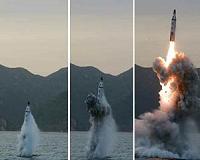
The recent test launch of a North Korean Submarine-Launched Ballistic Missile (SLBM) could be framed as just another event in a recent surge of new weapons test by the state. North Korea has conducted a flurry of missile launches in recent months, marking the debut of some new weapons that could possibly avoid Anti-Ballistic Missile (ABM) systems in nearby states.
But all of these earlier tests were of land-based systems. This is not the first time that North Korea has tested a SLBM and they have been working on submarines to carry them for years. But one nagging question still confounds analysts. Why is North Korea bothering to even develop such a system?
Submarines with ballistic missiles are probably the most potent weapons ever developed. They can prowl the world's vast oceans and hide undetected, staying below the surface for months at a time. They can protect themselves and elude pursuers. They can unleash enough firepower to destroy entire nations at short notice. With the end of the Cold War, the legendary cat-and-mouse games played by the world's major navies have somewhat subsided, but the potency of submarines remains evident.
North Korea's submarines simply don't make the grade for such strategies. They are slow, have limited range, and are easy to detect. They would be under observation (and probably close pursuit) by nearby navies as soon as they deployed from their bases, which are hardly in secret locations. Destroying them would be easy. Thus, they are clearly not the best platform for carrying expensive arsenals of nuclear weapons, but even using conventional warheads on their missiles seems like a bad choice.
Contrast this with mobile land-based systems, which can hide in hardened underground bunkers and roam to different locations, like a crude "find the pea under the cup" trick. From a purely strategic perspective, North Korea is better off investing in land-based systems than sea launches.
So, why bother to develop these systems, which must surely consume a considerable amount of resources? One reason could be a crude attempt to simply diversify the nuclear delivery options, in case land-based systems become too easy to track and destroy. But there could also be an element of inter-service rivalry at work.
Perhaps the Navy (a branch of the Korean People's Army) is simply jealous of the ground forces of the Army. Similar rivalries have affected the armed forces of other nations, and influenced the development and deployment of nuclear weapons in the USA.
