
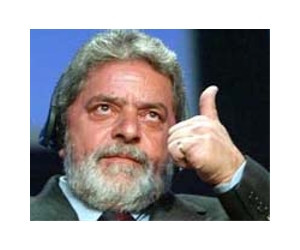
Brazilian President Luiz Inacio Lula da Silva hit out at the United States Thursday, challenging its muscular approach on Iran that sidelined diplomatic efforts he made this week to resolve the showdown.
Newspaper columnists "say that it was none of Brazil's business to be an intermediary with Iran. But who said it was a matter for the United States?" he asked after returning from an overseas tour that included Tehran.
"The blunt truth is, Iran is being presented as if it were the devil, that it doesn't want to sit down" to negotiate.
To the contrary, said Lula, "Iran decided to sit down at the negotiating table. It wants to see if the others are going to go along with what (it) has done."
In an implied swipe at the US government of President Barack Obama, Lula added: "There are people who don't know how to do politics without having an enemy."
The bitter outburst to reporters in Brasilia came three days after Lula and Turkish Prime Minister Recep Tayyip Erdogan met with Iranian President Mahmoud Ahmadinejad in Tehran to secure a deal meant to stave off UN sanctions the United States is pushing for.
Initially hailed as a diplomatic master stroke, the deal fell by the wayside on Tuesday when the United States submitted a UN resolution calling for a new round of sanctions against Iran, saying the Tehran agreement was insufficient.
Brazil and Turkey, the two non-permanent members of the UN Security Council most opposed to the resolution, immediately sent a letter calling for the resolution to be dropped and their deal to be considered.
Lula said he believed his contribution upheld the spirit of multilateralism.
He added that the media backlash at home over his perceived failure was part of the "inferiority complex" Brazilians felt when pitted against the traditional Western powers.
"We went to Iran and we succeeded, after 18 hours of meetings… to get Iran to do what the UN Security Council had been asking it to do for the past six months," he said.
He also highlighted the case of a young French teacher, Clotilde Reiss, accused of being a French spy by Iran, who was released to return home during his visit to Tehran, although he stopped short of saying that that had been a bargaining chip in the negotiations.
"We were talking for four and half months to get her freed. Nobody knew that, except us," Lula said.
A top Iranian MP, deputy parliamentary speaker Mohammad Reza Bahonar, said Tehran will withdraw from the Brazil-brokered deal to swap low-enriched uranium for fuel for a research reactor if sanctions are applied, the ISNA news agency reported.
Turkish and Brazilian diplomats, meanwhile, said Turkish Prime Minister Recep Tayyip Erdogan would be traveling to Brazil next week to speak with Lula.
earlier related report
Proposed UN sanctions could force Iran to shift its stance: US
Washington (AFP) May 20, 2010 –
Fresh UN sanctions against Iran along with additional measures taken by governments could force Tehran to change its stance on uranium enrichment, US Defense Secretary Robert Gates said Thursday.
He said the proposed sanctions would underscore Iran's isolation and also provide a "legal platform" for countries and organizations, including the European Union, to take tough action against Tehran over its nuclear program.
While previous UN resolutions had failed to alter Tehran's policy, "the ratcheting up of what other countries are willing to do on their own using the resolution as a basis does have the potential to change behavior."
Iran's elaborate efforts to block the UN Security Council resolution suggested Tehran was worried about the effect of another round of sanctions, the defense secretary said.
"If the resolution did not have an impact in Iran, it's not clear to me why the Iranians would have made — are making and have been making such an extraordinary effort to prevent it from being passed," Gates said.
"If it were irrelevant as far as they were concerned, I don't think you'd see them expending the kind of diplomatic and other kinds of energy to try and prevent its passage."
The fourth round of sanctions would expand an existing arms embargo, measures against Iran's banking sector and ban it from mining uranium and developing ballistic missiles overseas, according to a US official in New York.
Gates said "the resolution provides a new legal platform that allows individual countries and organizations, such as the EU, to take significantly more stringent actions on their own that go way beyond, well beyond what the UN resolution calls for in and of itself."
France expects a majority of the 15-member Security Council to support the resolution, diplomats said Thursday.
Washington and its allies have dismissed a deal brokered by Turkey and Brazil in which Tehran agreed to send around half its stock of low-enriched uranium to Turkey in exchange for more highly-enriched nuclear fuel.
earlier related report
France sees majority backing for Iran sanctions
Paris (AFP) May 20, 2010 –
France expects a majority of UN Security Council members to vote for new nuclear sanctions against Iran which would stop Russia selling ground-to-air missiles to the Islamic republic, diplomats said Thursday.
French Foreign Minister Bernard Kouchner said only three of the 15 members of the Security Council were holding out.
Diplomats named the three as Brazil and Turkey, which on Monday signed a uranium enrichment deal with Iran, and Lebanon, whose government includes pro-Iranian politicians.
Turkey and Brazil have called on UN Security Council members to give negotiations with Iran a chance and "avoid measures that are detrimental to a peaceful solution of this matter."
"I think that the text will be approved. I can't be certain, nobody can be certain," Kouchner told a small group of reporters.
If none of the council's five permanent members veto the text then a majority of the 15-strong committee is all that is needed for the fourth round of sanctions on Iran, which the West accuses of seeking nuclear weapons.
The UN resolution would expand an existing arms embargo, measures against Iran's banking sector and ban it from mining uranium and developing ballistic missiles overseas, according to a US official in New York.
Russia is one of the veto-wielding permanent members and western diplomats said the sanctions would include stopping sales of Russian S-300 surface-to-air missiles to Iran.
The United States and Israel worry the missile systems could be used to protect against possible future air strikes against Iran's nuclear sites.
The missile sale has already been agreed but Russia's state arms exporter said it would comply with any UN order.
"Any sanctions introduced by the UN are obligatory for arms exporting countries," Rosoboronexport spokesman Vyacheslav Davidenko told AFP. "Russia is no exception. Russia always complies with the sanctions."
But Iran's first nuclear plant, which Russia is building in Bushehr, should go online by August regardless of any new sanctions, a top Russian atomic official said.
"We are counting on the nuclear power station launching in August, if everything goes as planned," Sergei Kiriyenko, head of Russia's federal atomic energy agency, was quoted as saying by Russian news agencies.
"The resolution now being prepared on Iran will not in any way affect this."
Russia, which has long enjoyed close ties with Iran, has backed the US-proposed draft resolution, exasperated by Iran's intransigence and despite a surprise nuclear deal agreed between Iran, Brazil and Turkey this week.
The five permanent members of the UN Security Council — Britain, China, France, Russia and the United States – are discussing appendices to the sanctions text that will go before the full body, diplomats said.
According to a copy of the draft, seen by AFP, the sanctions would ban the sale of tanks, armoured fighting vehicles, large calibre artillery, war planes, attack helicopters, warships, missiles and missile defence systems to Iran.
Share This Article With Planet Earth
