
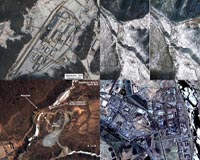
The recent demolition of North Korea's nuclear test site at Punggye-Ri made for good television, but has produced surprisingly little in the way of serious technical analysis. This is understandable, given the way that access to the site was heavily restricted and controlled. But the lack of boffin fodder leaves plenty of room for speculation.
There was plenty of theatre to behold. Explosives were used not only on the tunnels but on small buildings that would typically be demolished by more conventional means. The small media pool admitted to the site was allowed to see a short distance inside the tunnels before the detonations. Officially, that's about all we got, apart from a short briefing from the site's military commander (or someone who claimed to be this officer) with an official map of the site.
Technical experts were not permitted in the media pool, and attempts to make the reporters into amateur boffins were thwarted. CNN correspondent Will Ripley openly stated on his network that radiation detectors brought with the media pool had been confiscated by North Korean officials. This denied the outside world some technical data, but it also compromised attempts to monitor the radiation exposure of the visiting personnel for health reasons.
We still don't really know how deep the explosives were placed in the tunnels, or how far they have really collapsed. Nor did we really learn anything more about the overall architecture of the site, which has been scrutinized extensively by satellites.
This analyst has no Deep Throat sources, but suspects that deeper analysis is taking place in less open areas. Clothing and equipment brought to the site could potentially trap small amounts of radioactive particles.
A forensic swabbing of this material, followed by analysis with a mass spectrometer and other tools, could be productive. Similar processes occur at airports, when baggage and clothing is tested for explosives.
Analysts could obtain a "fingerprint" of the fissile material used in the nuclear tests, allowing such North Korean material to be identified elsewhere. This could be useful if this material is exported or stolen. The "fingerprint" would include the ratios of different radioisotopes and well as other materials.
One critical issue would be the potential presence of uranium signatures. North Korea is known to operate uranium enrichment gear, presumably to produce uranium-based nuclear weapons. But we are not sure if uranium has ever been used in any North Korean nuclear test.
Most, if not all, are suspected to have used plutonium generated in the Yongbyon nuclear reactor. Attempts to detect radioisotopes from the more recent North Korean tests in the atmosphere have been unsuccessful. Thus, the potential use of uranium is one of the most pressing unanswered questions.
It's possible that no uranium will be detected. But that would not necessarily mean that North Korea does not have some form of uranium bomb. A simple but reliable uranium bomb can be assembled without actual testing. That was done in the Manhattan Project. The first actual detonation of this device was over Hiroshima.
