
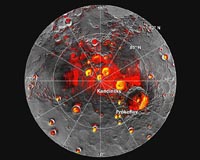
Images beamed back from the NASA's Mercury Messenger mission show that in the deep, dark, bowl-shaped cavities of the planet closest to the sun sits ice — water ice.
Mercury isn't exactly the first place one would expect to find frozen water. Being the closest planet to the sun, its surface temperature soars, but the sun never gets high enough in Mercury's sky to shine into the planet's craters. And because the planet has almost no atmosphere, little heat is actually trapped. Dark places like a crater never heat up; they stay cold enough to freeze water.
In the 1990s, the Arecibo radio telescope in Puerto Rico detected strong radar reflections coming off the north pole of Mercury, a good sign there might be ice. These reflections closely corresponded with craters documented by NASA's Mariner 10 spacecraft, which observed the small planet in the 1970s.
More recently, NASA's Messenger probe took a closer look, and what it found was rather surprising. Not only did more detailed imagery suggest there's lots of water locked up in some of the deep craters, it also indicated some of the ice is relatively fresh. Scientists can tell by the relatively stark and uniform contrasts that craters display on radar images.
"One of the big questions we've been grappling with is 'When did Mercury's water ice deposits show up?'" lead author Dr. Nancy Chabot, said in a news release. "Are they billions of years old, or were they emplaced only recently? Understanding the age of these deposits has implications for understanding the delivery of water to all the terrestrial planets, including Earth."
Researchers say understanding exactly how water deposits arrived on Mercury, as opposed to, for example, Earth's moon, will help scientists better understand the history of water in the solar system.
A study of Mercury's ice-filled craters was recently published in the journal Geology.
