
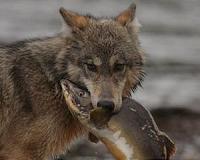
Three men in Washington State have now had the honor of choosing a wolf pack's name after each located previously undiscovered wolf pairs and pups.
After officials with the Washington Department of Fish and Wildlife confirmed the new wolf packs, they were given names chosen by the men who first reported their whereabouts.
Washington is publicizing its naming practice as a way to encourage volunteers to help biologists and wildlife officials locate and track wolves roaming across the large, rural state.
In order to have a wolf pack named in one's honor, citizens must locate a previously undocumented pair of wolves, one female and one male, traveling together. The wolves don't have to have offspring to be considered a pack. Though the wolf population in the Northwest has been getting healthier each year, the predators remain federally protected endangered species.
"Washington is a big state and we can't be everywhere," Scott Becker, coordinator for wolf tracking efforts with the state wildlife agency, told Spokane's Spokesman-Review. "The information we get from the public is invaluable."
The three men, who now have had the honor of naming wolf packs, come from three distinct backgrounds — backgrounds which are often at odds over wolf management policies. But all three share a love of the outdoors.
Steve Gilbertson is a hiker and avid conservationist who got a tattoo of a wolf in remembrance of his discovery. Ross Hurd is a rancher who is hopeful the wolves choose to settle down somewhere farther from his cattle. Bob Jensen is a hunter who named his wolf pack in honor of another man, Craig Goodman, who introduced Jensen and his brother to the hunting opportunities around Walla Walla.
Like Jensen, Gilbertson also named his wolf pack in honor of a friend.
"Mike Carpenter introduced me to that area when he learned I liked to hike, bike and watch for animals," Gilbertson said. "He got sick and died young in 2011. Showing me that area near Boyer Mountain, where his family hunts, was one of the most significant things anyone has ever shared with me."
Carpenter now lives in Virginia, but he still has motion-triggered trail cameras set up in Washington in hopes of capturing footage of more wildlife. He's headed back west to check the cameras later this fall.
