
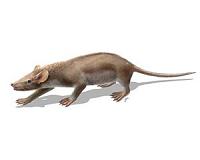
Until recently, scientists believed four-legged land animals first evolved warm-bloodedness roughly 270 million years ago. But a new analysis suggests the feature emerged 20 to 30 millions years earlier.
Warm-blooded animals don't need to sunbathe to regulate their internal temperature, their metabolism keeps them sufficiently warm. It's an ability shared by most mammals.
In addition to regulating body temperature, warm-bloodedness also enable a faster growth rate.
"And this is shown in the structure of the bones," Martin Sander, a professor of paleontology at the University of Bonn, said in a news release.
Research shows the more orderly a bone's collagen fibers, the more stable it is. But such stability takes time. The bones of warm-blooded mammals grow more hastily — and it shows. Mammalian bones feature a structure called fibrolamellar.
While analyzing the 300-million-year-old bones of an ancient mammalian predecessor named Ophiacodon, Sander and his colleagues discovered fibrolamellar patterns.
"This indicates that the animal could already have been warm-blooded," said Sander.
Ophiacodon grew up to six feet in length and resembled a large lizard. Reptiles and mammals share a common ancestor. On the family tree, Ophiacodon is situated close to the mammal-reptile split.
Researchers suggest their findings — detailed in the journal Comptes Rendus Palevol — raise the possibility that the first reptiles were actually warm-blooded.
"This raises the question of whether its warm-bloodedness was actually a completely new development or whether even the very first land animals before the separation of both branches were warm-blooded," Sander said.
Jurassic drop in ocean oxygen lasted a million years
Dramatic drops in oceanic oxygen, which cause mass extinctions of sea life, come to a natural end – but it takes about a million years.
The depletion of oxygen in the oceans is known as "anoxia", and scientists from the University of Exeter have been studying how periods of anoxia end.
They found that the drop in oxygen causes more organic carbon to be buried in sediment on the ocean … read more
