
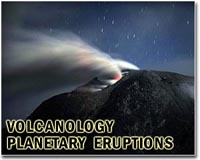
Colombia's Nevado del Ruiz volcano erupted in an ash cloud on Sunday, prompting authorities to temporarily close two airports in the area.
The civil aeronautics agency said it closed airports at Manizales and Pereira as a precaution after the 8:30 am (1330 GMT) eruption.
This resulted in the cancellation of at least 16 flights on Sunday.
A major eruption of the Nevado del Ruiz in 1985 melted the volcano's snowcap, unleashing mudslides that wiped out the town of Armero, killing an estimated 23,000 people.
The volcano, which has been active for an estimated 150,000 years, is 220 kilometers (137 miles )west of Bogota.
NASA's CATS cam spots Raung Volcano plume at night
Washington (UPI) Jul 24, 2015 –
How do you spot a volcano plume in the middle of the night from an altitude of 250 miles? You just call on the services of the International Space Station and its Cloud-Aerosol Transport System (CATS).
On July 12, the system picked up the stream of ash coming from Raung Volcano, the stratovolcano on the Indonesian island of Java, that began erupting once again in June. Raung has erupted 13 times over the last quarter century.
The CATS instrument uses lasers to detect various wavelengths of light. Its main purpose is to measure cloud layer height, thickness and depth. But its light range detecting abilities make it well-suited for observing a range of atmospheric particulates — including pollution, dust, smoke and aerosols.
Though perched on ISS, CATS doesn't offer a bird's eye-view. Instead, the sensor provided a cross section view of the plume, a horizontal vantage.
Researchers paired a CATS slice with an aerial image captured by the Visible Infrared Imaging Radiometer Suite (VIIRS) on the Suomi NPP satellite, which senses the longwave, or thermal, end of the electromagnetic spectrum.
Warmer areas in the image taken by VIIRS appear in light colors (grey and white), while cooler portions show up dark.
