
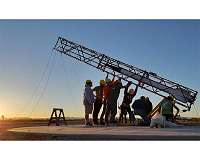
USC's undergraduate rocketry group, has announced that their latest vehicle, Traveler IV, crossed the 62-mile high Karman Line into space with 90% certainty. This result, which is the product of a publicly available internal analysis, makes Traveler IV the first entirely student-designed-and-built rocket to fly to space, as well as the highest flying such craft (doubling the previous altitude record) and the first university rocket to be successfully recovered from space.
Most importantly, the flight of Traveler IV brings to a close a quiet, intense space race that has kept the world's top engineering colleges locked in competition for over a decade-and may begin a new age of collegiate space exploration.
Over 80 undergrads were directly involved in the design, construction, and launch of Traveler IV, and the entire effort-from designing circuit boards and machining parts, to arranging airspace clearance with the FAA-was conducted and led entirely by the students.
The launch was a cultural event as well as a feat of engineering and logistics. Over 100 lab members, alumni, and other thrill-seekers drove with the rocket from USC's Los Angeles campus to New Mexico's Spaceport America, where the launch took place on April 21, 2019. The attendees camped in tents under the stars for the duration of the 3-day event, culminating in the carefully orchestrated 7:30 a.m. launch that saw the rocket fly to 339,800 ft (64.4 miles), with a top speed of 3386 mph.
USCRPL has competed with a variety of other space teams since its founding in 2004, and Traveler IV is the lab's fourth attempted space shot. Other frontrunners in the race include established teams from Princeton, MIT, Boston University, UCSD, Berkeley, and Portland State, as well as top international contenders such as Delft University (Netherlands) and TU Vien (Austria).
According to RPL's Lead Engineer, Dennis Smalling, who graduated from USC this spring with a B.S. in Astronautical Engineering, "After nearly 15 years and probably over a million hours of work, RPL has finally achieved its goal of being the first student group to launch the first student designed and built rocket past the Karman line."
In response to the successful launch, USC Viterbi School of Engineering's Dean Yannis Yortsos said, "We are proud of the tradition and of the indomitable spirit of innovation and perseverance of the RPL teams over the years.
This remarkable moment is a testament to their ingenuity and dedication. Such learning experiences create a new breed of engineers, who, like many of their RPL predecessors, are poised for making a positive change in the world."
"Traveler IV proves that college rocketry can contribute significantly to mainstream science and engineering. RPL and the other teams are doing stuff that's genuinely never been tried before, on budgets that previously would have been called 'impossibly low' for any space-qualified organization," commented RPL's Avionics Lead, Conor Hayes, who graduates this December with a B.S. in Computer Engineering and Computer Science.
Like the close of the international space race decades before, crossing the Karman Line is only the beginning for RPL and the rest of the collegiate space teams. RPL plans to capitalize on its newly proven launch capabilities by launching research payloads into space, and is already hard at work developing a liquid-fueled rocket that offers better control than the solid-fueled Traveler IV.
USCRPL is the world's premier undergraduate research group for experimental rocket technologies. Founded in 2005 with the mission of putting a scratch-built rocket into space, USCRPL has spent the last 14 years becoming a world leader in the design, manufacturing, and testing of small, low-budget, high-performance rockets.
RPL's members are all undergraduates, but alumni work across the space industry at organizations such as SpaceX, Blue Origin, and NASA, as well as RPL alumnus-founded startups like Relativity Space, Ursa Major Technologies, and 121C.
