
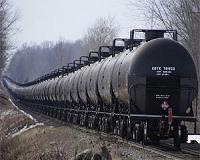
The American Petroleum Institute said it filed a lawsuit against the U.S. Department of Transportation challenging a federal timeline for oil-train safety.
U.S. Transportation Secretary Anthony Foxx hosted Canadian Transport Minister Lisa Raitt in Washington to announce new standards for "stronger, safer rail tank cars" carrying flammable liquids like crude oil through North America.
By Jan. 1, 2018, the U.S. rule mandates the retrofit or removal from the rail fleet for oil transport of cars designated DOT-111. The Canadian government set a May 1, 2017, deadline.
Brian Straessle, a spokesman for the American Petroleum Institute, said the industry was frustrated with those timelines.
"Improving on a 99.997 percent safety record requires data-driven efforts to prevent derailments with enhanced inspections and maintenance, upgrade the tank car fleet and educate first responders," he said in response to emailed questions. "Our safety goal is zero incidents, so retrofit timelines, braking systems and other actions must all be based on facts and science to maximize the safety impact of this rule."
DOT-111 cars were involved in a series of oil-train incidents in both the United States and Canada, including a deadly 2013 crash in Lac-Megantic, Quebec. A March derailment of a CSX train carrying crude oil through West Virginia involved newer CPC-1232 model rail cars.
API said its review of an earlier federal report on rail found kinetic energy built up during a derailment may play a greater role than cargo in any detonations.
From the rail industry itself, BNSF Railway in April announced it will require trains hauling crude oil to reduce their speeds in communities with more than 100,000 residents and work to remove all rail cars designated DOT-111 from service within a year.
The Department of Transportation last year issued a safety alert saying the type of crude oil in the Bakken reserve area of North Dakota may be more flammable than other grades. The North Dakota Petroleum Council followed with its own study saying crude oil taken from the Bakken shale does not pose a greater risk when transported by rail.
API, in its suit filed against the Department of Transportation, argues the federal mandates are "arbitrary" and go beyond statutory jurisdiction.
