
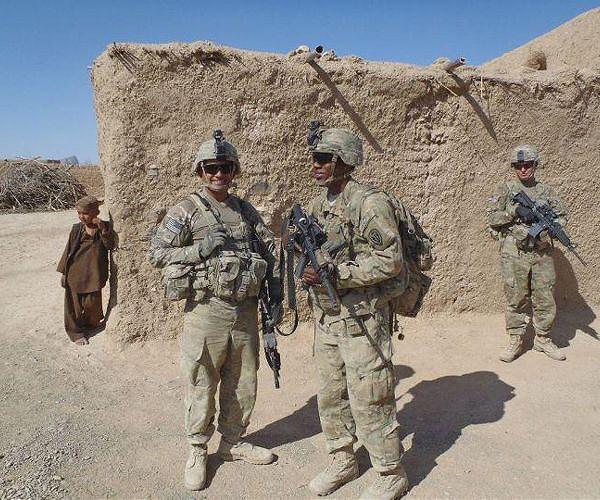
US Special Forces deployed around the world are at their lowest level since 2001, their chief, General Richard Clarke, said Thursday in Washington.
"Today, we have nearly 5,000 SOF deployed to 62 countries," the Special Forces command chief said in a document released on the sidelines of a hearing before the Senate Armed Services Committee.
That is down 15 percent from last year and the lowest number since 2001, the document said.
In addition, the Special Forces, which include elite Army Green Berets, Navy Seals and units from the Marines and Air Force, will pivot to Asia, in line with the US military strategy that focuses on China and Russia, after a 20-year struggle against Islamist extremism, said Clarke.
By 2021, "nearly 40 percent of our deployed forces will focus on GPC requirements," he said, referring to great power competition.
The United States never publishes the number of Special Forces deployed to each country. These elite military personnel usually rotate through countries experiencing instability, such as Libya and recently Somalia.
Former President Donald Trump, eager to put an end to "endless wars," had decided at the very end of his mandate, in December, to recall the majority of elite soldiers from Somalia, after having accelerated the disengagement from Afghanistan and Iraq.
Upon taking office, President Joe Biden limited the US military's use of drone strikes against extremist groups outside Afghanistan, Syria and Iraq.
While Trump had given the military carte blanche in countries such as Somalia or Libya, any planned strikes against militant groups there are now submitted to the White House before being executed.
Army readies new gender-inclusive Combat Fitness Test
Washington DC (UPI) Mar 26, 2021 –
The latest version of the Army Combat Fitness Test, with separate scoring for male and female soldiers and the third in three years, was rolled out this week.
The test includes gender-based performance scoring tiers, and the inclusion of "the plank," a static exercise in which a soldier's arms are used to raise him or her off a floor, holding the body straight.
It is an alternative to "the leg-tuck," in which a soldier hangs from a pull-up bar, tucking knees to the chin, an exercise which female soldiers find to be the most challenging.
Both available exercises are a measure of core strength, and older male soldiers benefit from the choice as well, .
"It allows for us to account for those in the service who have been in for 15, 20, 30 years that have never been asked to build the upper body strength that's necessary to do something like a pull up or the leg-tuck," Maj. Gen. Lonnie Hibbard, chief of the U.S. Army Center for Initial Military Training, U.S. Army Training and Doctrine Command told Stars and Stripes.
"It's significantly hard to [build strength] at that age, so by having an alternative event [the plank] we can still evaluate core strength," Hibbard said.
The six-event ACFT is performed annually, with scores and evaluations a part of a soldier's permanent military record.
The 3.0 version of the test will begin in April, with scores not counting until April 2022, Army Sgt. Maj. Michael Grinston told Army Times.
The relatively low scores for female soldiers, when not adjusted to take physiological differences of gender into account, worried lawmakers concerned that promotions and advancement for service women would be slowed.
In scoring, the six events will offer 100 points each, with 360 the minimum number amassed to pass the test.
The new evaluation system is expected to also offer five performance categories: green, bronze, silver, gold, and platinum, based on ACFT performance by male and female soldiers.
The platinum cohort could represent the top 1 percent of all scores, while green band could represent the lowest 50 percent of the total force.
"The scoring averages for male and female soldiers may vary, but the minimum standard will remain gender neutral," an Army statement earlier this week said.
U.S. Army to allow women to wear ponytails with all uniforms
Washington DC (UPI) Mar 26, 2021 –
The U.S. Army plans to allow the wearing of ponytails by female soldiers, regardless of uniform, U.S. Army Sgt. Maj. Michael Grinston announced.
In a Twitter question-and-answer session on Thursday, Grinston said that the wearing of ponytails, currently restricted to physical training exercises and allowed while wearing the Army Combat Uniform, will be extended to Army service and dress uniforms.
He did not announce an official date for the change in policy, which is part of an all-branches push to re-evaluate practices which could put women and Black service members at a disadvantage.
The exact wording of the order is still under consideration, he added.
"Working out the details, but 1-2 ponytails in all uniforms, down to the shoulder blade," Grinston wrote, adding that input from soldiers led officials to reconsider appropriate hair styles.
The Air Force changed its rules in February, allowing women to wear their hair in up to two braids or a single ponytail.
The rule requires the bulk of hair to not exceed the width of the head and length to not extend below a horizontal line running between the top of each sleeve inseam at the under arm through the shoulder blades.
In addition, women's bangs may now touch their eyebrows, but not cover their eyes.
A similar rule is expected from the Army.
"This is one way we are working to improve the lives of our soldiers, by putting people first, understanding their concerns, taking action when necessary and maintaining their razor-sharp edge of readiness," Lt. Gen. Gary Brito, deputy chief of staff for Army Personnel, said in January.
