
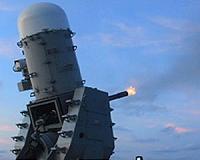
The U.S. Navy has awarded Raytheon with a $159 million contract to produce and maintain Phalanx Close-in Weapon Systems, the company announced on Friday.
The contract includes support equipment for both the Phalanx and SeaRAM weapon systems, Block 1B radar upgrades, and an overhaul of four land-based Phalanx Weapon Systems. Rick Nelson, vice president of Raytheon's Naval and Area Mission Defense product line says the new products to be delivered to the Navy will allow vessels to perform more tasks on their own.
"Phalanx provides the U.S. Navy's ships with a 'last-chance' defense against anti-ship missiles and littoral warfare threats while SeaRAM extends that inner-layer battlespace," Nelson said in a statement. "Close-in systems give warfighters the ability to automatically carry out functions usually performed by separate systems on other ships."
The Phalanx is a rapid-fire, computer-controlled radar-guided gun system designed to meet threats up close from sea platforms, such as anti-ship missiles and other incoming threats. The system is also useful for providing early warnings for attacks.
Marketed as a self-contained package, the Phalanx comes equipped with search, detection, threat evaluation, and tracking capabilities. It uses an infrared sensor to track and engage helicopters, high speed aircraft, and land-based threats. The U.S. Navy equips all combatant ship classes with the Phalanx.
Milestone achieved in Frigate modernization program
Ottawa (UPI) Oct 22, 2015 –
Lockheed Martin Canada reports its planned update of New Zealand Navy frigates has successfully passed its combat system critical design review.
The government-required review validated all the company's planning for the frigates' shipboard systems and designs, paving the way for their implementation, Lockheed Martin said.
Lockheed Martin Canada was contracted by New Zealand 16 months ago to modernize two ANZAC-class frigates. The foundation for the modernization will be the company's Combat Management System 330, the backbone for many of the sub-systems to be supplied for the project.
Many of those sub-systems are common to the Royal Canadian Navy's Halifax-class ship modernization project.
"I continue to be impressed with Lockheed Martin Canada's flexibility, responsiveness and pragmatic approach to achieving a successful outcome for both parties," said Gary Collier, New Zealand Ministry of Defense project director. "We are pleased to have Lockheed Martin Canada as the prime contractor and partner for this critical project for New Zealand's Ministry of Defense and the Royal New Zealand Navy."
