
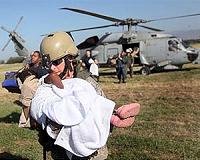
Two weeks after Hurricane Dorian devastated the Bahamas, U.S. military forces began winding down their rescue efforts.
The hurricane hovered over the island nation for about 40 hours beginning on Sept. 3, and the United States military has been involved in relief efforts since.
Navy and Marine personnel returned to Norfolk, Va., this week after providing support to the U.S. Agency for International Development. Amphibious transport ships, helicopters and personnel of the Bataan Amphibious Ready Group, Helicopter Mine Countermeasure Squadron HM-14 and HM-15, and Helicopter Sea Combat Squadron HSC- 9 and HSC-26 were involved.
Their duties included aviation and logistics support across the islands; delivery and dispersal of water, food, medical supplies, search-and-rescue gear, tarps and solar lights; and transportation of personnel from the USAID Disaster Assistance Response Team, the United Nations Office for Coordination of Human Affairs and a U.S. Air Force Airfield Assessment Team, the Navy said in a statement.
A priority was the quick clearing of airfields, and the airlift capability was specifically requested by the Bahamian government. As the U.S. military responded to the Bahamas, it closed several of its own installations on the Atlantic and Gulf Coasts in anticipation of the hurricane's landfall on the mainland.
The United States sent USAID representatives to the Bahamas within hours after the Category 5 hurricane passed.
The U.S. Coast Guard announced on Tuesday that its five cutters and five helicopters, deployed to assist emergency responders, returned to their U.S. home stations. In two weeks of relief work it received 1,388 search and rescue calls and rescued over 400 people.
U.S. Transportation Command holds 28-ship sealift readiness exercise
Washington (UPI) Sep 18, 2019 –
The U.S. Transportation Command began a five-day "turbo activation" of its Ready Reserve Force to test its ability to quickly deploy cargo ships required for a massive troop movement.
The exercise involves 28 fully-crewed ships in the no-notice exercise, an unprecedented number which is expected to provide a better assessment of sealift readiness, USTRANSCOM officials said Tuesday.
The ships left from undisclosed ports on the Atlantic and Pacific oceans, as well as on the Gulf Coast, with at least 1,000 merchant marine personnel involved.
Typically, only a few ships are involved in such exercises, but the deployment started Tuesday is the largest since 2003 and the fourth turbo activation this year. It involves ships of the Military Sealift Command and the U.S. Department of Transportation's Maritime Administration, monitored by the Joint Chiefs of Staff and USTRANSCOM.
The exercise demonstrates the readiness of the ships and tests their ability to meet activation time standards and Department of Defense mission requirements.
The activated ships are directed to transition from a reduced operating status with a skeleton crew to a fully-crewed status, with quarters made habitable and cargo gear ready, within five days. Activations are generally immediately followed by a sea trial, USTRANSCOM said.
The Military Sealift Command's "surge fleet," which includes 15 roll-on/roll-off, or ro-ro, cargo ships, is involved, as are ships of the Maritime Administration, which includes 35 ro-ro ships and 11 "special mission ships."
The Maritime Administration's vessels have capabilities including heavy lift cranes and aviation maintenance shops. One of the special mission ships, the M/V Cape Ray, carried elaborate equipment to support the destruction of Syrian chemical weapons in 2014.
