
The US government has declassified the fact it held nuclear weapons on Okinawa in Japan during the Cold War, though the matter had long been an open secret.
A Department of Defense website states the Pentagon has declassified "the fact that US nuclear weapons were deployed on Okinawa prior to Okinawa's reversion to Japan on May 15, 1972."
The National Security Archive at George Washington University welcomed the disclosure, but pointed to US Air Force photos depicting nuclear weapons on the island that have been publicly available for more than 25 years.
"However welcome the release may be, its significance is somewhat tempered by (that) astonishing fact," the non-governmental research group said in a statement Friday.
The group added that the US government had wasted an "inordinate" amount of time and resources by delaying the declassification.
Japan is the only nation to have been attacked with nuclear weapons. The United States dropped atomic bombs on Hiroshima and Nagasaki in 1945, killing more than 210,000 people and leading to Japan's surrender in World War II.
Japan has since campaigned to abolish the weapons. Former prime minister Eisaku Sato won the Nobel Peace Prize largely for his "three principles" — that Japan will not possess, produce or allow nuclear weapons on its soil.
Okinawa remained under US control until 1972, and many parts of the archipelago are still used for US bases.
Thousands surround Japan parliament in protest at US base plan
Tokyo (AFP) Feb 21, 2016 –
Thousands of protesters formed a human chain around Japan's parliament Sunday in protest at the planned construction of a new US base on the southern island of Okinawa.
Some 28,000 people, according to local media, surrounded the building holding banners reading "No more US bases in Okinawa" and "Follow the will of Okinawa".
Many wore blue, the colour symbolising support for the island.
Police did not give an estimate of the number taking part in rhe rally, the latest in a long series of protests.
The dispute has intensified mistrust between the central government and the southern island chain.
Okinawa accounts for less than one percent of Japan's total land area but hosts about 75 percent of US military facilities in the country.
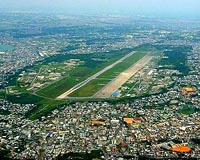
The central government wants to construct a new US Marine air base in a remote part of the island to replace the existing US Futenma air base in heavily populated Ginowan, where it is widely seen as a potential danger to residents.
But Okinawa governor Takeshi Onaga and many island residents want a replacement for Futenma built outside Okinawa — either elsewhere in Japan or overseas.
They say they can no longer live with the noise, accidents and occasional crimes by US service members.
Japan and the United States first proposed moving Futenma in 1996. But they both insist the replacement base must remain in Okinawa, from where US troops and aircraft can respond quickly to potential conflicts throughout Asia.
Tokyo is keen to keep its crucial security ally satisfied, but frustration over the seven-decade American military presence is rife in Okinawa.
