
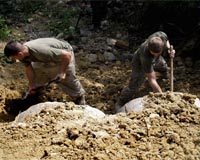
The remote town of Pio Duran, with its palm-and thatch-roofed homes, had never known a decent road, while a decades-long communist insurgency lurks threateningly in the background.
So it is little surprise that, while they are accused by some of being "occupiers" in places like Iraq and Afghanistan, US Marines have been warmly welcomed in the impoverished and sometimes dangerous central region of Bicol.
"This is Bicol, so (the insurgency) is an ever-present factor," the local mayor, Roger Arandia, told AFP of the 5,200-member New People's Army (NPA).
"But everyone needs a road," he added.
It is by no means on the scale of reconstruction efforts in the Middle East, for example, but the Marines are on a "hearts and minds" mission here that is winning them many friends locally — and inevitably drawing a few enemies too.
As well as roads, they have rebuilt typhoon-damaged schools, treated 22,000 residents with various ailments and even given anti-rabies shots to pets in what is one of the poorest regions in the whole of the Philippines.
"I don't get into the whys of an insurgency or anything. What I'm here to do is help people," said Brigadier-General Ronald Bailey, commander of a US Marine expeditionary brigade consisting of around 40 troops.
They are a small part of the more than 6,000 US soldiers involved in military exercises in Bicol, Luzon and Mindanao.
The non-combat segment allows Washington to dispense its largesse to earn goodwill in the former US colony's poorest areas, which are typically troubled by insurgencies — many of them long-running.
It took about a month to turn a three-kilometre (two-mile) dirt track into a proper road linking Pio Duran to the coastal resort of Donsol, where most visitors to Bicol head, said Marine Staff Sergeant Chad Anderson.
The locals' response was "outstanding. They appreciated it a lot," Anderson, from Maine, told AFP.
But the threat from the NPA is never far away. They have warned they are prepared to attack the American forces, although there have been no reported direct assaults yet.
However, they have come close, wounding one local soldier who was part of a Filipino unit guarding the Marines as they built another road.
While the Americans have tried to avoid getting involved with the issue of the communist insurgency and say their role is to improve basic services for the locals, some Filipinos hope they will indirectly also be making it safer.
Building roads "enables the government to bring basic services, so naturally it has an immediate impact on the insurgency," said Filipino Defence Secretary Gilberto Teodoro.
He added the rebellion has persisted for so long — 40 years, to be precise — "because we have not been able to address it properly due to lack of manpower."
Some even hope the US forces could expand their remit to include combat operations against the NPA.
It has some precedent in the Philippines. In the south of the country US Special Forces military advisers are already embedded — albeit in a strictly non-combat role — with Filipino troops battling Islamic militants.
No specific figure has been put on the number of people killed in the four-decade rebellion here, but some military sources say the number runs into many thousands.
US ambassador to the Philippines, Kristie Kenney, would not rule out helping the government in Manila fight the rebels in Bicol in some as yet undefined way.
"Right now we are very happy with where we are in our relationship," Kenney told AFP.
"But we're friends and allies, and we'll listen if the government of the Philippines suggests something new."
Back on the ground, the US medics and Marine engineers assigned here on their short-term assignment hope the benefits of their work will be felt long after they have gone.
A fierce typhoon in 2006 killed about 1,000 people in the town of Guinobatan, left countless others in need of medical attention that was not available and destroyed the only very ramshackle medical centres.
"Many patients have seen doctors and they say they hold them in high esteem," said Commander Catherine Yates, a US Navy doctor, as she tended to patients at a makeshift clinic.
"But they can't afford them. Many people say that," added Yates.
Share This Article With Planet Earth
