
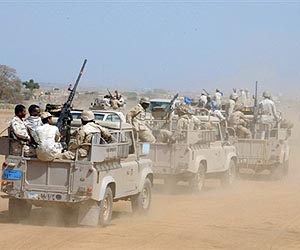
The US military conducted in May a secret air strike against a suspected Al-Qaeda target in Yemen and killed a deputy provincial governor in the process, The New York Times reported late Saturday.
Citing unnamed US officials, the newspaper said the air strike hit a group of suspected operatives for Al-Qaeda in the remote desert of Marib Province.
But it also killed the province's deputy governor, a respected local leader who Yemeni officials said had been trying to talk Al-Qaeda members into giving up their fight, the report said.
Yemen's president, Ali Abdullah Saleh, accepted responsibility for the death and paid blood money to the offended tribes, the paper noted.
According to The Times, the strike was a secret mission by the US military, and it was at least the fourth such assault on Al-Qaeda in the mountains and deserts of Yemen since December.
The paper said the United States has now significantly increased military and intelligence operations in areas ranging from the deserts of North Africa, to the mountains of Pakistan and to former Soviet republics.
It is pursuing militants with robotic drones and commando teams, paying contractors to spy and training local operatives to chase terrorists, the report said.
Virtually none of the newly aggressive steps undertaken by the United States government have been publicly acknowledged, the paper said.
related report
Fall in US public support for Afghan war 'worrisome': Jones
President Barack Obama's national security advisor has voiced concern about Americans growing weary of the war in Afghanistan, despite what he called apparent "elements of success."
Asked in an interview whether US engagement in Afghanistan risked the same loss of support that undermined the war in Vietnam, James Jones replied that such a prospect was "very worrisome."
"The biggest fear would be that we might get to a point where we decide that we can't turn this violence around," the retired US Marine Corps general told CNN on Thursday, adding that he doubted that would happen.
A USA Today/Gallup opinion poll released earlier this month indicated that 60 percent of Americans thought the situation for the United States in Afghanistan was "very or moderately bad."
Public support for Obama's management of the conflict meanwhile fell to 36 percent, from 48 percent in February.
On the progress of the war in Afghanistan, Jones said: "The elements of success are all present, and they are visible. We know what they are. We are working very hard with both sides, on both sides of the (Afghan-Pakistan) border."
"Specifically in Pakistan, we need to see more activity on the part of the Pakistani army to go after the insurgents in the safe havens that allow the transit between Afghanistan and Pakistan to go on," he added.
"This is fundamentally important."
Jones acknowledged that parts of the Pakistan military "have played both sides in years past, because of their uncertainty with regard to our long-term stay and long-term commitment."
"Hopefully," he said, those elements will become "increasingly part of the solution."
Share This Article With Planet Earth
