
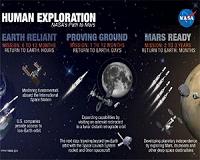
Experts in their new report are warning US President Barack Obama about possible failure of NASA project with astronauts reaching Mars in 2030s. In their 285-page review of human spaceflight program, experts from National Research Council specify that NASA lacks viable strategy for getting there. Budget of project is too small to succeed, they add.
According to Jonathan I. Lunine, a Cornell astronomer and a co-chairman of the committee, "There is not a believable plan for getting there in a finite period of time."
The experts believe that NASA should set specific milestones; they call it "steppingstones" on the way to Mars.
For now, NASA has a vague idea what should be done once the project is complete, what will be the next step there. Are they going to send a heavy rocket that will carry all the necessary equipment on Mars? For now, the first unmanned launching is scheduled in 2017 and a second launching, with astronauts, in 2021.
For now, a big question remains on whether general public will support the government spending so much money on a project like this. Even during the 1960s, while NASA was preparing the Apollo missions, the public was not very supportive. Only once the project proved to be a success, the attitude of people has changed.
Dr. Lunine believes that with steppingstones, people would look more positive at what had already been accomplished and that will raise chances of people continuing to support the project.
For now, the panel has come up with three different possibilities of the mission. Greg Williams, deputy associate administrator for policy and plans in NASA's human exploration and operations mission directorate, stated that the agency would think more about the options and get back with a solution by the end of the year.
In addition to that, the panel said NASA's annual budget is $17.5 billion. And this number is likely to stay the same in the upcoming years. According to experts, if to allow spending to rise at 2.5 percent a year that would offset inflation and open possibilities.
The conclusion of the National Research Council report is very simple: in order for the mission to be successful, NASA needs a consensus from political leaders over two or three decades.
But the tension between the Obama administration in advocating the asteroid mission and the Congress that is pushing for the moon could continue until the next president takes over in 2017.
"I think that is highly likely," said John M. Logsdon, a former director of the Space Policy Institute at George Washington University. "Verging on certain."
