
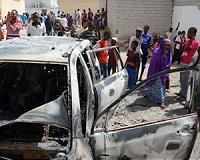
US forces said Friday that two civilians had died in an airstrike in Somalia, the first time it has admitted non-combatant deaths since launching a wave of missiles targeting jihadist fighters.
The toll of two civilians deaths, from an April 2018 strike, is still far lower than the number investigators from Amnesty International believe have been killed.
The rights group last month reported 14 civilians had been killed from only five airstrikes they had examined, out of a total 110 missile blasts.
But the admission of deaths by US force marks a notable shift in a previous blanket denial of any civilian killings.
US strikes, which included missiles fired by manned aircraft as well as drones, targeted Somalia's Al-Qaeda linked jihadist insurgents, Al-Shabaab.
Following Amnesty's claims in March, the US Africa Command, AFRICOM, said it killed over 800 people in a total of 110 airstrikes in Somalia since April 2017, but insisted every death was that of a "terrorist."
On Friday, however, the US military said in a statement that they had now found two civilians had been killed in an airstrike last year, in Somalia's central El Burr regin.
"An April 1, 2018 airstrike killed two civilians," the statement read. At the time, on April 2, 2018, the US had said no civilians were killed, but that five Al-Shabaab had died. On Friday, it said four Shabaab fighters died.
No further details of the civilians killed by the US missiles were given/
The civilian deaths had not been recorded due to a to a "reporting error", the statement said, but were revealed after a military review was ordered "due to a recent increase in airstrikes and continued interest by Amnesty International and Congress on civilian casualties."
US strikes in Somalia surged in April 2017, after President Donald Trump declared southern Somalia an "area of active hostilities", Amnesty said.
The rate of airstrikes has also risen sharply. The 110 attacks the US said it has carried out since April 2017 includes 28 airstrikes in 2019 alone, compared to 47 in all of 2018, and 35 in 2017.
Amnesty warned that some attacks "may amount to war crimes."
The Shabaab have been waging an insurgency against Somalia's foreign-backed government for over a decade, and while it has lost ground, continues to stage deadly attacks.
At least 170 civilians killed in Cameroon conflict since October: HRW
Libreville (AFP) March 28, 2019 –
At least 170 civilians have been killed since October in fighting in English-speaking western Cameroon between separatists and government forces, Human Rights Watch said Thursday.
"Government forces in Cameroon's anglophone regions have killed scores of civilians, used indiscriminate force, and torched hundreds of homes over the past six months," the rights group said in a report.
The group based its findings on interviews with 140 victims, family members and witnesses between December and March, it said.
"Since October, at least 170 civilians have been killed in over 220 incidents… according to media reports and Human Rights Watch research," it said.
Another 31 members of the security forces were killed in operations between October and February, it said.
"Given the ongoing clashes and the difficulty of collecting information from remote areas, the number of civilian deaths is most likely higher," it added.
HRW did not explicitly blame government forces for all 170 civilian deaths.
It said armed separatists assaulted and kidnapped dozens of people during the same period, executing at least two men.
The government sent a letter to HRW denying "exactions" by the army described in the report, the group said.
The conflict broke out in October 2017 when the anglophone separatists launched an armed campaign.
The International Crisis Group has said the death toll since the start of the fighting has topped 500 for civilians and more than 200 for members of the security forces.
English speakers, who account for about a fifth of Cameroon's population of 24 million, have chafed for years at perceived discrimination in education, law and economic opportunities at the hands of the francophone majority.
The anglophone movement radicalised in 2017 as the authorities refused demands for greater autonomy for the Northwest and Southwest Regions.
On October 1 that year, separatists declared the creation of the "Republic of Ambazonia" in the two regions, named after the local Ambas Bay. The declaration has not been recognised internationally.
"Cameroon's authorities have an obligation to respond lawfully and to protect people's rights during periods of violence," said Lewis Mudge, HRW's Central Africa director. "The government's heavy-handed response targeting civilians is counterproductive and risks igniting more violence."
Some 437,000 people have fled the fighting, according to the United Nations, which called Tuesday for $184 million (163 million euros) to help the displaced.
