
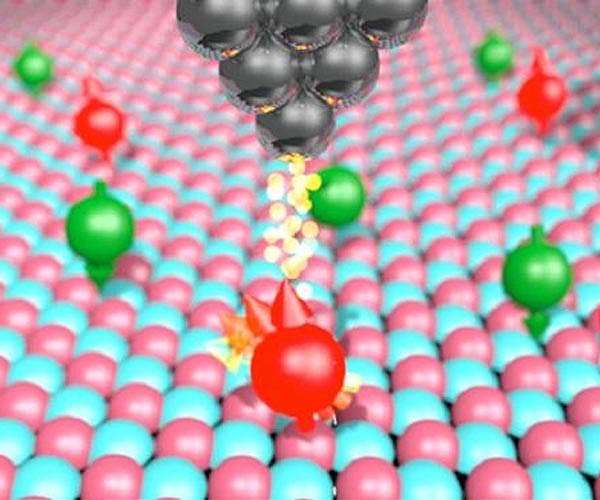
Professor Dong Eon Kim and his team at POSTECH, in collaboration with the Max Planck Institute for Nuclear Physics, have experimentally revealed a long-standing quantum mystery: what happens to electrons inside a tunneling barrier. This breakthrough, published in Physical Review Letters, marks the first time the internal dynamics of electrons during tunneling have been directly observed.
Quantum tunneling, where electrons seemingly defy classical physics by passing through energy barriers they shouldn't be able to overcome, underpins technologies like semiconductors and processes such as nuclear fusion. Although scientists have long understood tunneling's start and end points, the path electrons take through the barrier remained elusive-until now.
Using powerful laser pulses to induce tunneling in atoms, the researchers discovered that electrons do more than just pass through the barrier-they collide again with the atomic nucleus within it. This phenomenon, named "under-the-barrier recollision" (UBR), challenges previous theories which held that such interactions could only happen after the electron emerged from the tunnel.
Remarkably, the team also observed that electrons gain energy during this intrabarrier encounter, intensifying a process known as Freeman resonance. This led to higher ionization rates than previously recorded and appeared largely independent of laser intensity-a result that current quantum models could not predict.
The findings pave the way for a deeper understanding of tunneling and more precise manipulation of electron behavior in cutting-edge applications, from quantum computing to ultrafast laser technologies.
"Through this study, we were able to find clues about how electrons behave when they pass through the atomic wall," said Professor Kim. "Now, we can finally understand tunneling more deeply and control it as we wish."
Research Report:Unveiling Under-the-Barrier Electron Dynamics in Strong Field Tunneling
