
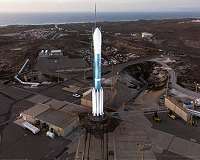
A United Launch Alliance (ULA) Delta II rocket is in final preparations to launch NASA's Ice, Cloud and land Elevation Satellite-2 (ICESat-2) spacecraft from Space Launch Complex-2 on Sept. 15. This marks the final launch of the Delta II rocket, which first launched on Feb. 14, 1989.
"This is the end of an era, as we prepare to launch the final Delta II rocket," said Gary Wentz, ULA vice president of Government and Commercial Programs.
"This vehicle has truly created a legacy throughout its history launching NASA, critical U.S. military satellites and commercial clients."
From its origin as the launch vehicle for the first Global Positioning System (GPS) satellites to NASA's Earth observing, science and interplanetary satellites – including Mars rovers Spirit and Opportunity – to vital commercial communication and imaging satellites, the Delta II rocket has justly earned its place in space history.
ICESat-2, with its single instrument, the Advanced Topographic Laser Altimeter System (ATLAS), will provide scientists with height measurements to create a global portrait of Earth's third dimension, gathering data that can precisely track changes of terrain including glaciers, sea ice, forests and more.
Northrop Grumman built the spacecraft. In addition to ICESat-2, this mission includes four CubeSats which will launch from dispensers mounted to the Delta II second stage.
This mission will launch aboard a Delta II 7420-10 configuration rocket, which includes a 10-foot-diameter payload fairing (PLF). The booster for this mission is powered by the RS-27A engine and the second stage is powered by the AJ10-118K engine.
