
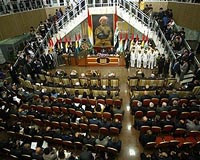
Political parties in Iraq's Kurdish region, whose president's mandate expired in August, should respect democratic principles, the top UN envoy said Wednesday.
Jan Kubis' warning came after a week that saw protests against regional president Massud Barzani turn violent and the leading opposition party kicked out of government.
What started as demonstrations over unpaid salaries in regions dominated by the opposition to Barzani's Kurdistan Democratic Party escalated into protests demanding he step down.
At least four people were killed, dozens wounded and local offices of the KDP in several southern towns were burnt down.
"Perpetrators of these acts of violence should be quickly brought to justice, following due judicial process," Kubis, UN chief Ban Ki-moon's representative in Iraq, said in a statement.
But he also stressed that all parties in the northern autonomous region, a key partner in the global fight against the Islamic State group, should respect democracy.
Kubis urged "the authorities and political forces of the region to ensure the proper functioning of the political system and its institutions, political parties and their offices, in full conformity with democratic principles and methods."
Barzani's mandate expired in August but the 69-year-old, at the helm of Iraqi Kurdistan since 2005, wants to stay in power, arguing that his leadership is needed to fight terrorism.
Negotiations between the parties sharing power have failed.
Barzani's camp accused Gorran, the second-largest party in Kurdistan, of instigating the protest violence.
The KDP subsequently blocked Gorran's leaders, including the parliament speaker, from reaching their workplace in the regional capital Arbil and declared the party to be out of government.
The resurfacing of geographical and linguistic divisions has raised the spectre of the civil war of the mid-nineties that split the region into two entities administered separately for years.
Iran Guards say two commanders killed in Syria
Tehran (AFP) Oct 14, 2015 –
Iran's Revolutionary Guards said Wednesday that two of its senior officers have been killed in Syria, just days after the death of a general from the elite unit.
The Guards website announced the death of colonels Farshad Hasounizadeh and Hamid Mukhtarband, who "were martyred in recent days while advising and helping the Syrian resistance army".
The commanders' bodies would be buried in Khouzestan province, southern Iran, it said.
On Tuesday, an Iranian state television reporter working in Syria announced on Instagram the deaths of both men, whom he said were killed Monday, identifying Hasounizadeh as a brigadier general.
Colonel Mukhtarband was formerly a brigade commander in the southern Iranian city of Ahvaz.
The news comes the same week the Guards announced their highest-profile casualty in the effort to shore up President Bashar al-Assad.
General Hossein Hamedani, who had undertaken 80 missions in Syria according to a eulogy at his funeral in Iran, was killed in the key battleground city of Aleppo.
Shiite-dominated Iran is Assad's strongest regional ally, sending military advisers from the Guards and other forces to help him against Sunni Muslim rebels seeking his overthrow.
Lebanon's Shiite militia Hezbollah has done much of the fighting to prop up the Syrian army.
The commander of the Revolutionary Guards' foreign wing, Major General Qassem Soleimani, is said to be heavily involved in guiding military strategy.
