
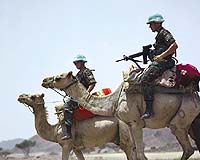
The UN Security Council voted unanimously Wednesday to deploy 5,200 UN troops to take over from the European Union mission in Chad and the Central African Republic (EUFOR) in mid-March.
Resolution 1861 also decided to extend for one year until March 15, 2010 the mandate of the UN mission in the Central African Republic and Chad (MINURCAT) to ensure the security and protection of civilians in the two countries.
The French-drafted text decided that the 540-strong MINURCAT shall be beefed up to include "a maximum of 300 police officers, 25 military liaison officers, 5,200 military personnel and an appropriate number of civilian personnel."
It authorized MINURCAT's military contingent "to follow up on EUFOR in both Chad and the Central African Republic (two former French colonies) at the end of its mandate."
EUFOR began a year-long mission last March to protect MINURCAT and refugees from western Sudan's strife-torn Darfur region, as well as some 450,000 people displaced by the rebel insurgency in Chad and the north of Central African Republic.
The EU force is comprised of around 3,300 soldiers drawn from 14 countries, although France makes up around half the contingent.
The resolution endorsed benchmarks, outlined in a recent report by UN chief Ban Ki-moon, which MINURCAT is meant to achieve.
These include "a voluntary return and resettlement in secure and sustainable conditions of a critical mass of internally displaced persons and the demilitarization of refugee and internally displaced person camps.
The UN mission is also tasked with helping Chadian authorities in the east of the country provide the necessary security for refugees, internally displaced persons, civilians and humanitarian workers with respect for international human rights standards.
The resolution also directed Ban to inform the council in his subsequent reports "on the development of a strategic workplan containing indicative timelines to measure and track progress on the implementation of the benchmarks…with a view to meeting them by March 15 2011."
A Western diplomat, speaking on condition of anonymity, said the benchmarks could serve as models for improving other UN peacekeeping missions.
"We are reaching the limits of the availability of forces and of the willingness of member states to pay (for UN peacekeeping missions)," he noted.
He added that this has led French and British UN planners to initiate "a review of peacekeeping missions" to look at their performance and how they can be improved.
Share This Article With Planet Earth
