
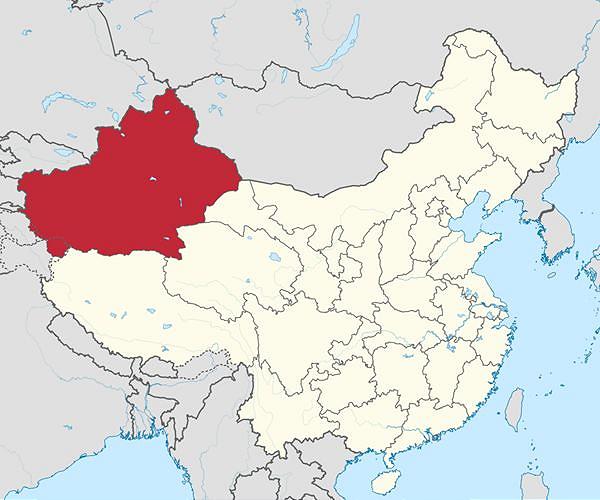
The UN acknowledged Friday that a widely anticipated report on human rights in Xinjiang, where China stands accused of serious abuses against minority Uyghur Muslims, will not be published before the Olympics.
Pressure has been mounting on the United Nations Rights Office to publish its report quickly, amid fears that China will use the Beijing 2022 Winter Games, which start next week, to distract from alleged wide-scale rights violations in Xinjiang.
Last week, lawmakers in Washington, which accuses China of genocide against Uyghurs in the far western region, called for the urgent release of the report.
The call has been echoed by rights groups, which charge that at least one million Uyghurs and other mostly Muslim minorities have been held in camps in Xinjiang — allegations Beijing vehemently denies.
In mid-December, rights office spokesman Rupert Colville had said the report was expected out in "a few weeks" but on Friday he told journalists it was now "clear it is not going to come out before the Olympics start".
– UN rights chief visit? –
His comment came after Hong Kong's South China Morning Post newspaper indicated that Beijing had agreed to a long-awaited visit to Xinjiang by UN rights chief Michelle Bachelet after the Olympics end on February 20 — hinting that, in exchange, it expected her office to hold off publishing the report.
Colville said the way the paper had characterised the situation was "not correct in our view", insisting that the report and Bachelet's visit were "separate" issues.
"There are still ongoing discussions about a possible visit during the first half of this year," he said. "(But) the parameters of that visit are still very much under discussion."
"Clearly it's not going to take place before the start of the Olympics."
Beijing has long said Bachelet would be welcome to visit Xinjiang, but has so far not agreed to allow her the "meaningful and unfettered access" she has been seeking.
"From our side, it's important that such a visit be meaningful, with unsupervised access to a wide range of civil society actors and locations, as well as a level of engagement with government officials," Colville said.
Chinese foreign ministry spokesman Zhao Lijian meanwhile said Friday that Beijing stood by its longstanding invitation and would welcome Bachelet "to come to China and visit Xinjiang".
"China's position has always been clear. The purpose of a visit is to promote exchanges and cooperation between the two sides," he said.
Colville rejected rumours that the rights report would be put on ice indefinitely, but stressed it involved complex and time-consuming fact-finding and verification.
"I don't exactly know where we are now, but I know we're in the final stages," he said.
Taiwan will not send delegation to Beijing Olympics ceremonies
Taipei (AFP) Jan 29, 2022 –
Taiwan will not send an official delegation to the opening or closing of the Beijing Winter Olympics due to China's strict pandemic controls and flight disruptions, the self-ruled island's governing body for sport said.
The decision comes at a time when relations between Beijing and Taipei are at their lowest in decades with China ramping up military and economic pressure under President Xi Jinping.
Taiwan's Sports Administration said late Friday that its 15-member delegation will not attend the opening and closing ceremonies due to "pandemic prevention and flight schedules".
Its tiny winter team, which includes four athletes, will be flying to China from the United States, Switzerland and Taiwan, the administration added in a statement.
"According to the event's pandemic prevention and entry policy, flights have been adjusted and delayed, and not all could arrive in Beijing by the opening ceremony on Feb. 4."
Authoritarian China regards democratic Taiwan as its own territory and has vowed to one day seize it, by force if needed.
Record numbers of Chinese jets are now buzzing around the island's air defence zone and the People's Liberation Army has staged regular drills simulating an invasion.
China has cut off official communication with the government of President Tsai Ing-wen since 2016 because she regards Taiwan as an already sovereign nation.
The last time Beijing hosted an Olympics in 2008, relations with Taiwan were much warmer and a large delegation visited.
Taiwan and Beijing have argued for decades about representation at the Olympics.
Since 1981, Taiwan has had an agreement with the International Olympic Committee to compete under the name Chinese Taipei.
It was a compromise that would allow Taiwan to compete in sports without presenting itself as a sovereign nation.
