
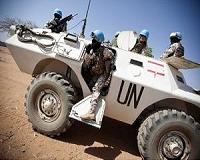
The United Nations is reaching out to China as it pulls together a standby force of 15,000 troops for quick deployment to conflict zones, the UN peacekeeping chief said Thursday.
Although Herve Ladsous did not name the countries that will take part in the new reserve force, he does plan to travel to China early next month to discuss its offer of 8,000 troops.
"The goal we are pursuing is that, by the end of the year, we would have the capacity of 15,000 people ready for deployment within a very short period," he told reporters.
China made a splash last year when it announced that it was ready to set up an 8,000-strong standby force to bolster UN peacekeeping.
That would put Beijing among the top contributors of UN troops and police.
China's offer was "remarkable," Ladsous said, praising Beijing for contributing peacekeepers to South Sudan and a squadron of transport helicopters to Sudan.
"These are very welcome factors," he said.
The standby force will be fully trained and equipped for peacekeeping missions, which is expected to reduce deployment time by several months.
More than 100,000 soldiers and police serve in the UN's 16 peacekeeping mission worldwide, the bulk of them provided by a small group of countries.
They include Bangladesh, India, Pakistan, Ethiopia and Rwanda.
UN airs 'deep concern' over church curbs in north Cyprus
Nicosia (AFP) May 26, 2016 –
The United Nations said Thursday it was "deeply concerned" over new curbs on access to Greek Cypriot churches in the Turkish-held north of the divided island.
Turkish Cypriot authorities have restricted the number of visits allowed to Greek Orthodox churches in the north, saying they were unable to cope with the frequency of and demand for religious services.
Most churches are now being restricted to one service a year.
But UN envoy Espen Barth Eide urged a rethink because the policy was contrary to the UN-brokered peace process encouraging contact between civil society from both sides of the divide.
"I have learnt with deep concern about the changing policy on access to religious sites in the north," Eide told reporters after meeting Turkish Cypriot leader Mustafa Akinci.
"After many years of very positive improvement on the ability to access churches, we have learnt of a new policy which seems to be more restrictive."
The envoy said he urged Akinci to try to have the situation "rectified" as it was contrary to the bicommunal spirit created over the past year.
Christian and Muslim leaders have come together on the island to support the peace process and encouraged religious worship across the island.
Long-stalled UN-brokered peace talks — seen as the last best chance to reunify Cyprus after four decades of division — were launched in May 2015.
Cyprus has been divided since 1974 when Turkish troops occupied its northern third in response to an Athens-inspired coup seeking union with Greece.
