
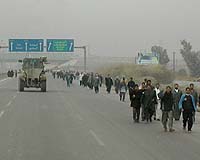
UN Secretary-General Ban Ki-moon offered Wednesday to help Iraq restore basic services to Ramadi and allow refugees to quickly return to the city after it was recaptured from jihadists.
Ban made the offer during a telephone conversation with Iraqi Prime Minister Haider al-Abadi who visited Ramadi after his forces drove out Islamic State fighters.
Describing the recapture of Ramadi as "an important victory," Ban "stressed the need for measures to be taken to restore the rule of law as well as basic services in Ramadi as to allow for the return of internally displaced persons as soon as possible."
He offered UN support, said a statement from his spokesman.
Iraqi officials on Wednesday described widespread destruction in Ramadi from months of fighting with more than 3,000 homes ruined and roadside bombs and other explosive devices strewn across the city.
Ban also expressed concern over the abduction of Qatari nationals in Iraq in December and urged Abadi "to do everything possible to ensure their prompt and safe return."
The 26 Qatari nationals were on a falconry expedition in southern Iraq when they were abducted at their camp by gunmen who turned up in dozens of pick-up trucks.
Among those kidnapped are members of the Qatari royal family. Ban said the group included children.
Thousands of homes destroyed in Iraq's Ramadi: official
Baghdad (AFP) Dec 30, 2015 – Months of fighting in Ramadi have caused extensive destruction, officials said Wednesday, warning that it was too soon for civilians to return to the Iraqi city after its recapture from jihadists.
Iraqi forces declared victory on Sunday night in the Ramadi battle after wresting back control of the city's central government complex from the Islamic State group.
Some jihadist fighters have yet to be flushed out, mostly on the eastern edge of the city, and many reconquered areas have yet to be fully cleared of roadside bombs and booby traps.
"There is extensive destruction in the city as a result of terrorist activity and military operations," said Ibrahim al-Osej, a member of the Ramadi district council.
IS fighters had laid thousands of explosive devices across Ramadi as part of their defence against an offensive that was launched on December 22 by elite federal forces.
The US-led coalition supporting the Iraqi effort to reclaim the city, which was lost to IS in May, has also carried out around 630 air strikes in the Ramadi area since July.
"Preliminary estimates show that more than 3,000 homes have been completely destroyed" in Ramadi, which lies around 100 kilometres (60 miles) west of Baghdad, Osej said.
He said that the figure would grow because assessments could not be immediately carried out in some neighbourhoods that had not been cleared of mines.
"Thousands of other homes have suffered varying degrees of damage," Osej said.
"All water, electricity, sewage and other infrastructure — such as bridges, government facilities, hospitals and schools — have suffered some degree of damage," he said.
In the centre of Ramadi, which lies on the Euphrates river, "there are five bridges in various states of destruction," US operations officer Major Michael Filanowski said Wednesday.
"For all of them at least the span has dropped," he said, adding that he estimated it would take at least weeks to repair them.
Civilians began fleeing Ramadi, the capital of Anbar province, two years ago when tensions escalated there, and the exodus has continued until this week.
A few hundred families who had remained holed up in their homes during the fighting were evacuated by the army on Tuesday and taken to a facility in Habbaniyah, east of Ramadi.
The residents of Anbar account for more than a third of the 3.2 million people who have been displaced by conflict in Iraq since the start of 2014, according to the International Organization for Migration.
