
Perovskite solar cells promise cheaper and efficient solar energy, with enormous potential for commercialization. But even though they have been shown to achieve over 22% power-conversion efficiency, their operational stability still fails market requirements.
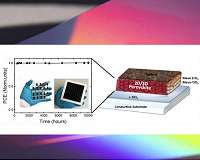
Despite a number of proposed solutions in fabrication technology, this issue has continued to undercut whatever incremental increases in efficiency have been achieved. EPFL scientists have now built a low-cost, ultra-stable perovskite solar cell that has operated for more than a year without loss in performance (11.2%). The work is published in Nature Communications.
The lab of Mohammad Khaja Nazeeruddin at EPFL in collaboration with Michael Gratzel and Solaronix company has engineered what is known as 2D/3D hybrid perovskite solar cell. This combines the enhanced stability of 2D perovskites with 3D forms, which efficiently absorb light across the entire visible spectrum and transport electrical charges.
In this way, the scientists were able to fabricate of efficient and ultra-stable solar cells, which is a crucial step for upscaling to a commercial level. The 2D/3D perovskite yields efficiencies of 12.9% (carbon-based architecture), and 14.6% (standard mesoporous solar cells).
The scientists built 10×10 cm2 solar panels using a fully printable industrial-scale process. The resulting solar cells have now delivered a constant 11.2% efficiency for more than 10,000 hours, while showing zero loss in performance as measured under standard conditions.
The breakthrough resolves the problem of perovskite solar-cell stability, and can viably move the technology into the commercial sphere.
Imec Presents Highly Accurate Model for Energy Yield Prediction of Photovoltaic Modules
At this week's Intersolar Europe, imec, the world-leading research and innovation hub in nano-electronics, energy, and digital technology, and partner in EnergyVille, will introduce simulation software that accurately predicts the daily energy yield of solar cells and solar modules under varying meteorological and irradiation conditions.
Imec's model combines optical, thermal and electrica … read more
