
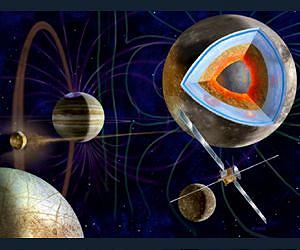
A UK led-led instrument has been selected to fly on Europe's JUpiter ICy moons Explorer (JUICE) mission, due for launch in 2022.
Selected today (21 February 2013) by ESA's Science Program Committee, the magnetometer instrument will measure the magnetic fields of Jupiter and its moons to gain an understanding of their internal structures and physical processes, and in particular, to confirm the existence of a sub-surface ocean on Ganymede.
UK involvement in the mission is funded by the UK Space Agency and includes roles in both the instrumentation and the space science team. Professor Michele Dougherty from Imperial College London is the lead scientist for the mission.
Dr. Chris Castelli, Acting Director of Science, Technology and Exploration at the UK Space Agency, said, "JUICE is an excellent example of the type of big national missions that UK scientists continue to win key involvement in. With their help, JUICE will make the most detailed characterization of the Jovian system ever obtained, revealing fresh insights into the habitability of the 'waterworlds' orbiting the giant planets in our solar system and beyond."
Planned for arrival at Jupiter in 2030, JUICE will carry a total of 11 scientific experiments to study the gas giant planet and its large ocean-bearing moons, Ganymede, Callisto and Europa.
These moons are thought to harbor vast water oceans beneath their icy surfaces and JUICE will map their surfaces, sound their interiors and assess their potential for hosting life in their oceans.
The complement of instruments approved today by ESA also includes cameras and spectrometers, a laser altimeter and an ice-penetrating radar, plasma and particle monitors, and radio science hardware. They will be developed by scientific teams from 15 European countries, the US and Japan, through corresponding national funding.
Throughout its mission, JUICE will also observe the interaction of all four Galilean satellites — the three icy moons plus Io — with the gas giant planet.
The spacecraft will perform a dozen flybys of Callisto, the most heavily cratered object in the solar system, and will fly past Europa twice in order to make the first measurements of the thickness of its icy crust.
JUICE will end up in orbit around Ganymede, where it will study the moon's icy surface and internal structure, including its subsurface ocean.
The largest moon in the solar system, Ganymede is the only one known to generate its own magnetic field, and JUICE will observe the unique magnetic and plasma interactions with Jupiter's magnetosphere in detail.
The selection of the instruments today helps to ensure that JUICE remains on schedule for launch in 2022.
