
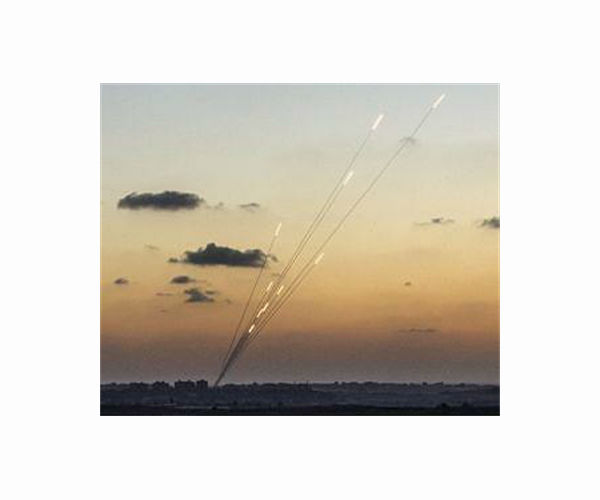
Two rockets targeted an airbase at Iraq's Baghdad airport housing US-led coalition troops on Sunday, in the second such attack in 10 days, the Iraqi army said.
One of the projectiles was intercepted by the C-RAM counter rocket, artillery and mortar system deployed to protect US troops in Iraq, a security source told AFP.
There was no immediate claim of responsibility for the attack which the army said caused no casualties.
Washington routinely blames Iran-linked Iraqi factions for such attacks on its troops and diplomats.
Sworn foes Tehran and Washington have both had a presence since 2003 in Iraq, where 2,500 US troops are still deployed.
Last week, three rockets crashed into the sector of the Baghdad airport base occupied by Iraqi troops, wounding one soldier.
Almost 30 rocket or bomb attacks have targeted American interests in Iraq — including troops, the embassy or Iraqi supply convoys to foreign forces — since President Joe Biden took office in January.
Two foreign contractors, one Iraqi contractor and eight Iraqi civilians have been killed in the strikes.
Dozens of other attacks were carried out from autumn 2019 under the administration of Biden's predecessor Donald Trump.
The operations are sometimes claimed by obscure groups that experts say are smokescreens for Iran-backed organisations long present in Iraq.
The strikes come at a sensitive time as the Islamic republic is engaged in talks with world powers aimed at bringing the US back into a 2015 nuclear deal.
The agreement, which curbs Iran's nuclear program in exchange for sanctions relief, has been on life support since Trump withdrew in 2018.
Pro-Iran Iraqi groups have vowed to ramp up attacks to force out the "occupying" US forces in recent months, sometimes against Tehran's wishes, according to some experts.
Baghdad last month reportedly hosted a secret meeting of senior officials from Tehran and US-ally Saudi Arabia.
Iraq, wedged between its eastern neighbour Iran and Saudi Arabia to the south, has been angling to become a mediator.
18 Iraqis killed in multiple night-time jihadist raids
Baghdad (AFP) May 1, 2021 –
Eighteen Iraqis, the majority military personnel, were killed overnight Friday to Saturday in separate jihadist attacks mainly in the greater Baghdad area, security sources told AFP.
There was no immediate claim of responsibility for the attacks, but they are in line with the modus operandi of the Islamic State group, which still has sleeper cells in Iraq despite its territorial defeat in 2017.
One attack targeted troops in Tarmiya, an agricultural suburb 20 kilometres (12 miles) north of the Iraqi capital.
"IS fighters attacked an Iraqi army convoy at night and killed two officers and two soldiers," a security official said, on condition of anonymity.
Reinforcements were dispatched to the area but also came under fire, with "an officer and two soldiers" killed, the source said.
A member of tribal fighters integrated into the regular forces that were then deployed to the scene was also killed, "along with a civilian caught in the crossfire", the source added.
Further north, in the central Alton Kubre region, "six peshmerga (Kurdish fighters) were killed when Islamic State group jihadists attacked their military position with light arms", another security official told AFP.
Alton Kubre is a disputed area claimed by both the federal government in Baghdad and the autonomous Kurdistan authorities.
Another attack took place in the western desert bordering Syria, a third security source said.
"An officer and a soldier were killed in a bomb explosion while an army convoy was en route to Akashat," he said.
A soldier was also killed in a bomb blast in Diyala province, which borders Baghdad to the east, according to another official, who added that two other fighters were also wounded in a separate attack.
Iraq in late 2017 declared victory over IS, which had overrun swathes of the country and neighbouring Syria three years earlier.
However, sleeper cells holed up in mountains and deserts continue to carry out deadly attacks across the country, often at night in remote areas and with light weapons.
Following the latest attacks, Iraqi President Barham Saleh called in a tweet for continued "effective international support to eradicate terror across the region".
A US-led military coalition has been in Iraq since 2014 to help fight IS but a vote in parliament last year called for the departure of all foreign troops from the country.
