
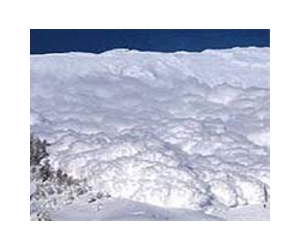
Two people died and dozens were missing Sunday, after a massive weekend avalanche in Western Canada hit a crowd of 200 snowmobilers in the mountainous backcountry.
Provincial teams including 40 rescue experts with dogs gathered to search for possible survivors or bodies, but the search was put on hold by authorities who feared more avalanches at the site, Corporal Dan Moskaluk told reporters.
Avalanche specialists flying in helicopters were assessing the risk Sunday. Police said two men were confirmed dead, after earlier reporting three fatalities, and said another 30 people were injured.
The snowmobilers were in a bowl beneath Boulder Mountain near Revelstoke, 566 kilometers (350 miles) northeast of Vancouver, when a wall of snow crashed onto the crowd.
The crowd was attending an informal backcountry snowmobile contest held annually, dubbed "The Big Iron Shoot Out," in which riders drive their machines up steep slopes to see who can score the highest "mark" near high mountain ridges.
The number of people affected was uncertain but Moskaluk told reporters that police who spent the night checking area hotels and winter campgrounds found dozens of empty hotel rooms whose occupants were not accounted for.
"A large number of people who were on the mountain did make it safely off… but there very well could be injured persons or deceased persons that may be there", he said.
earlier related report
Experts warn of monster mudslides in Taiwan
Taipei (AFP) March 11, 2010 –
Southern Taiwan could experience even bigger mudslides than those that buried hundreds alive last year, when the worst typhoon in half a century hit the island, experts warned Thursday.
Typhoon Morakot touched off massive landslides in August, killing about 700 people, including an estimated 400 buried in the village of Hsiaolin alone.
But experts said that worse could be in store.
"In the next 20 years or so, southern Taiwan could face many more mudslides, as the area is hit by typhoons and heavy rain. That's fate," said civil engineering professor Lee Hong-yuan of National Taiwan University.
The main reason why Morakot was so devastating was that it unleashed up to 400 million cubic metres (14 billion cubic feet) of sand and rock from hills and mountainsides.
However, Morakot also loosened up twice as much debris, which could now engulf lower-lying areas. "It could happen any time," said Lee, who was speaking at a seminar in Taipei.
Lee and other experts called on the government to adopt preventive measures, including new curbs on the use of land in mountainous areas.
"Otherwise, the pace of reconstruction would never be able to catch up with disasters," Lee said.
Reconstruction projects following natural disasters have cost the government 65 billion Taiwan dollars (two billion US) in the eight years to 2008.
The government has set aside more than 100 billion Taiwan dollars more to deal with the havoc wrought by Typhoon Morakot.
Share This Article With Planet Earth
