
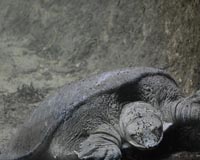
A Malaysian state that is a major nesting site for turtles will ban the trade in their eggs, authorities said Thursday, in a boost for the threatened creatures.
Turtles regularly crawl ashore to lay their eggs on beaches in northeastern Terengganu state, and the spectacle of babies hatching and scurrying into the sea is a major draw for tourists.
But numbers have declined rapidly over the decades as they are hunted for their meat and shells, while rampant poaching of their eggs is also a major threat.
Despite pressure from conservation groups, Terengganu continued to allow the trade in some species' eggs, which are a popular local delicacy and are sold openly in markets.
But authorities have decided to ban all egg trade by the end of the year due to a "sharp decline in arrivals of all types of turtle species in Terengganu," Azman Ibrahim, a senior politician in the state, told AFP.
"It is hoped that we can save marine life, protect the environment and help boost tourism revenue for the state."
He gave no indication of the proposed penalties for breaking the ban.
Terengganu, with a long coastline along the South China Sea, is the biggest nesting centre for turtles in peninsular Malaysia.
But it has seen a sharp fall in arrivals of Hawksbill and Olive Ridley turtles — two of the main species — said Azman.
The sale of critically endangered Leatherback turtles' eggs had already been banned after massive declines in the number of creatures coming ashore to nest.
Elizabeth John, a spokeswoman for wildlife trade watchdog Traffic, hailed the proposed ban as "a critical move to safeguard marine turtles".
Mohamad Uzair Rusli, a biologist working on saving sea turtles, also welcomed the "bold move" but warned that the rules must be strictly implemented.
Enforcing a ban may be difficult — selling and eating eggs is part of local culture in Terengganu, where some consider them aphrodisiacs.
Malaysia's states make their own laws relating to turtles and others, including Sabah and Sarawak on Borneo island, had already banned the sale of eggs.
Cher tweets joy as Pakistan agrees to free lonely elephant Kaavan
Islamabad (AFP) May 21, 2020 –
Music icon Cher marked "ONE OF THE GREATEST MOMENTS OF MY LIFE" Thursday after a Pakistani court ordered freedom for a lonely elephant named Kaavan, who had become the subject of a high-profile rights campaign backed by the US singer.
"WE HAVE JUST HEARD FROM PAKISTAN HIGH COURT KAAVAN IS FREE," Cher tweeted, adding a string of emojis and saying she felt "SICK".
"THIS IS ONE OF THE GREATEST MOMENTS OF MY LIFE," the effusive singer continued.
The Islamabad High Court has ordered wildlife officials to consult with Sri Lanka to find Kaavan a "suitable sanctuary" within 30 days, tweeted the Friends of Islamabad Zoo, which described itself as a group of citizens concerned about animal welfare at the zoo.
Outrage over treatment of Kaavan, an Asian elephant originally from Sri Lanka, went global several years ago with a petition garnering over 200,000 signatures after it emerged he was being chained at the Islamabad Zoo in Pakistan's leafy capital.
Zoo officials later said this was no longer the case, and that he just needed a new mate after his previous partner died in 2012.
But experts have told AFP previously that without a better habitat his future was bleak, even if a long-promised new mate finally arrives.
His behaviour — including signs of distress such as bobbing his head repeatedly — demonstrates "a kind of mental illness", Safwan Shahab Ahmad of the Pakistan Wildlife Foundation told AFP in 2016.
Activists said he had insufficient shelter from Islamabad's searing summer temperatures, which can rise to above 40 degrees Celsius (100 Fahrenheit).
Asian elephants can roam thousands of kilometres through deep tropical and subtropical forests, according to the World Wildlife Fund.
In contrast, Kaavan's 90 by 140 metre (100 by 150 yard) pen had almost no foliage, and only limited shade was provided.
Arriving as a one-year-old in 1985 from Sri Lanka, Kaavan was temporarily held in chains in 2002 because zookeepers were concerned about increasingly violent tendencies, but he was freed later that year after an outcry.
His mate Saheli, who arrived also from Sri Lanka in 1990, died in 2012, and in 2015 it emerged that Kaavan was regularly being chained once more — for several hours a day.
Scores of people signed a petition sent to zoo authorities and Pakistan's then-Prime Minister Nawaz Sharif in protest.
A second petition circulated in 2016 and backed by over 200,000 animal-lovers from across the globe demanded Kaavan's release to a sanctuary.
Cher, who for years has spoken out about Kaavan's plight, tweeted her thanks to the Pakistani government, adding "it's so emotional for us that I have to sit Down".
