
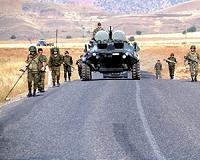
Turkey on Saturday said it would "continue" to pull its troops out of northern Iraq after US President Barack Obama urged President Recep Tayyip Erdogan to do so in order to de-escalate tensions with Baghdad over the deployment.
"Taking into account the sensitivities on the Iraqi side… Turkey will continue the process it has already begun to withdraw its troops stationed in Mosul province," the foreign ministry said in a statement.
The Iraqi government earlier this week demanded the "complete withdrawal" of Turkish troops from its territory after Turkey deployed soldiers and tanks to a military camp near the city of Mosul.
Baghdad labelled the deployment an illegal "incursion" but Turkey said it was to protect Turkish trainers working with Iraqi forces battling the Islamic State (IS) jihadist group.
In a phone call on Friday, Obama asked Erdogan to take steps "to de-escalate tensions with Iraq, including by continuing to withdraw Turkish military forces".
He also urged Turkey "to respect the sovereignty and territorial integrity of Iraq".
A senior Turkish official said last week that between 150 and 300 soldiers and 20 tanks were deployed to protect Turkish military trainers at the Bashiqa camp near Mosul.
Turkey began partially withdrawing troops from the area on Monday.
In its statement late Saturday, the foreign ministry said there had been a "lack of communication" with Baghdad on the matter and that Ankara "would continue to coordinate with the Iraqi government over its military contribution to the country in the fight against Daesh (IS)".
About 200 IS jihadists killed in Iraq offensive: US
Washington (AFP) Dec 18, 2015 – Some 200 Islamic State jihadists were killed by US-led coalition aircraft during an intense battle in Iraq this week, a US military spokesman said Friday.
Baghdad-based Colonel Steve Warren, who represents the US-led coalition that is attacking the IS group in Iraq and Syria, said about 500 jihadists had carried out an offensive against Iraqi Kurdish peshmerga forces in the northern province of Nineveh on Wednesday.
Coalition aircraft from five nations responded and dropped nearly 100 bombs during the overnight fight, he added.
"Air power alone killed nearly 200 of them, about 187 by last count," Warren told Pentagon reporters in a video call.
"So, a significant blow to this enemy. And then, of course, ground forces. We don't have a good count yet for how much damage the pesh (peshmerga) were able to inflict on this enemy during the course of this fairly long battle. But we know it was significant."
The multi-pronged IS offensive saw jihadist fighters target several areas including a base housing Turkish soldiers that has been at the heart of a bitter dispute between Baghdad and Ankara.
Peshmerga forces repelled coordinated attacks in Nawaran, Bashiqa, Tal Aswad, Khazr and Zardik, the Kurdistan Regional Security Council (KRSC) has said.
Warren said much of the fighting took place in Tal Aswad.
The KRSC, which is headed by de facto regional president Massud Barzani's son Masrour, previously said that more than 70 IS members were killed in the attacks.
Warren said Canadian special operations troops, who are in Iraq to help train Kurdish fighters, helped in the fight on the ground.
