
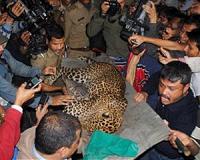
Two endangered leopards — including a rare black one — have been killed by snares in Sri Lanka in less than a week, sparking calls for authorities to crack down harder on the cruel traps.
A third was found alive in a snare and released back to the wild after being tranquilised.
In the latest case, the bloated carcass of a leopard was discovered Tuesday strangled by a wire snare on a cashew plantation on the edge of a forest reserve in Neluwa, some 145 kilometres (90 miles) southeast of the capital Colombo.
"It is possible that the trap was set for a sambar deer, but the leopard got caught instead," a wildlife official from the area told AFP.
A week earlier, a rare black leopard — also known as melanistic because the colour is a pigment condition rather than the mark of a separate species — was found trapped alive in the Nallathanni highlands, but died two days later.
The third leopard was found Friday at Yatiyantota, another highland nature area, before being released back into the wild.
Although setting snares in national parks and reserves in against the law, they are not illegal elsewhere and farmers often use them to protect crops or catch wild boar.
Sri Lankan conservationist Jayantha Jayewardene said the spate of leopard snaring might be villagers driven to desperation because the coronavirus lockdown had deprived them of income.
"For about two months these people have not had any work, and without money for food they are setting up snares to catch wild boar," Jayewardene told AFP.
"What we are facing is a bigger problem — not just a wildlife issue."
There are believed to be less than 1,000 leopards in the wild in Sr Lanka, and harming the big cat is punishable by up to five years' jail.
Sri Lanka's Wilderness and Wildlife Conservation Trust called for all snares to be banned, and those who set them to be prosecuted
"Snares are indiscriminate and therefore can kill any animal, either protected or not," the conservation group's trustee Anjali Watson told the Daily Mirror local newspaper.
"This (latest killing) is clearly seen as a case of incidental killing of leopards by snares. Hence they should be made illegal."
Pregnant elephant dies in India after eating explosive fruit trap
New Delhi (AFP) June 3, 2020 –
A pregnant elephant was killed in India after eating fruit stuffed with explosives, officials said Wednesday, sparking outrage over the use of such traps to protect crops and homes.
The wild elephant strayed into a village near Silent Valley National Park in south Kerala state last Wednesday when it ate the rigged fruit — believed to be a pineapple — which exploded and severely injured its mouth, officials said.
"We are investigating the nature of the explosive and as well as the food fed to her," Kerala's chief wildlife warden, Surendra Kumar, told AFP, adding local police were involved in the probe.
"We are investigating to find the people and circumstances that led to her death," he added.
Villagers in the region often use firecracker or explosive-filled pineapples — which act like pressure-activated landmines — to protect their fields from wild animals.
A similar incident took place last month when a female elephant was found with serious mouth injures in a nearby district, Kumar said, adding that it too died of its injuries.
There was widespread outrage on social media after a forestry officer's Facebook post on Saturday received almost 10,000 reactions or comments.
"She didn't harm a single human being even when she ran in searing pain in the streets of the village," Mohan Krishnan, wrote.
"She didn't crush a single home. This is why I said, she is full of goodness."
Photos of the pachyderm shared on social media showed it standing in a river after the incident, dunking its mouth and trunk in the water hours before she died.
Two captive elephants were brought to lead it out of the river but it remained unmoved, said Krishnan, who led the rescue team.
India has lost vast swathes of forest to urbanisation in recent decades, forcing animals closer to human settlements and resulting in an increasing number of encounters.
Some 2,361 people were killed in attacks by elephants between 2014 and 2019, according to data recorded by the government.
Some 510 elephants died in the same period, including 333 from electrocution and around another 100 from poaching and poisoning, the figures stated.
