
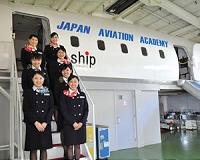
From training fighter pilots to drone operators, Japan Aviation Academy (JAA) is moving to keep pace with the needs of the times.
Japan Press Network met officials of one of Japan's oldest pilot training schools at the first annual Japan Drone 2016 expo held at Makuhari Messe, northeast of Tokyo, on March 24-26. The summit welcomed 118 exhibitors and over 8,000 guests.
JAA's appearance at the event was symbolic of the changing times. Opened in 1932, the Yamanashi-based school took responsibility for training many of Japan's first military pilots before the outbreak of World War II. It closed down in 1945 after Japan's surrender, then reopened in 1960 as the country geared up for its economic revival.
Today JAA operates a handful of campuses nationwide from the Kanto Area near Tokyo to Noto on the Japan Sea coast to Chitose in Hokkaido. It sports an English-education curriculum, hosts foreign students, and has support staff in China, Thailand, and Mongolia. Most of its techs, mechanics, and cadets go on to jobs at All Nippon Airways (ANA), Japan Airlines (JAL), and other major employers.
At its Niigata campus, the Academy currently hosts about 1,000 students. JAA managing director Koichi Mizuno puts the overall dropout rate at close to zero. "Students are committed to getting certified in their respective fields, be they cadets or mechanics or cabin attendants," he says. "The certification process keeps them motivated; they realize what's at stake."
Costs for high school level dormitory students run about 1.8 million yen annually and about 900,000 yen for commuter students. JAA's technical college also trains ground and various support staff, and offers internships with the major airlines as at a cost of about 1.2 million yen per year. Trainees practice on B-767 and YS-11 aircraft.
In the months and years ahead, the Academy will also have its eyes on training drone operators, following fervent industry calls for more qualified fliers. In doing so, JAA joins a growing group of institutions offering qualification courses. DJI Japan, a unit of the world's largest drone maker, began offering corporate drone training programs in early 2016, and plans to churn out 10,000 pilots over the next three years.
JAA launches its first class in April, using a model loosely based on the nation's automobile license training school (kyoshujo). Mr. Mizuno likens the urgency for good drone operators to the nation's call for training crack fighter pilots back in the 1930s. "The industry needs drone pilots, but it also needs training in basic safety," he says. "It's critical that we do both."
"The industry needs drone pilots, but it also needs training in basic safety. It's critical that we do both." — Koichi Mizuno
