
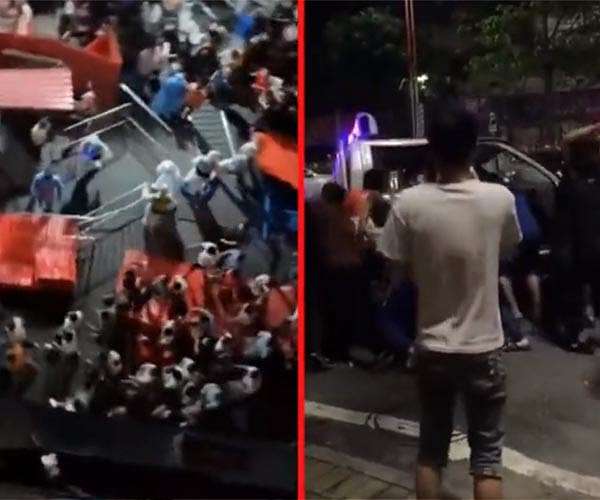
China's top security body on Tuesday called for a "crackdown" on "hostile forces" after the country saw protests in major cities opposing Covid lockdowns and demanding greater political freedoms.
The ruling Communist Party's Central Political and Legal Affairs Commission, which oversees all domestic law enforcement in China, said it was "necessary to crack down on infiltration and sabotage activities by hostile forces in accordance with the law," according to a readout of a meeting carried in state news agency Xinhua.
It also said it was crucial to "resolutely crack down on illegal criminal acts that disrupt social order in accordance with the law, and earnestly safeguard overall social stability."
China saw a weekend of protests not seen in decades as anger over unrelenting lockdowns fuelled deep-rooted frustration with its political system.
A deadly fire last week in Urumqi, the capital of the northwestern region of Xinjiang, was the catalyst for the outrage, with protesters taking to the streets in cities across China to pay tribute to the dead and call for an end to hardline Covid controls.
Some of the protesters have also used the rallies to call for greater freedom of expression and the resignation of Chinese leader Xi Jinping — bold demands in a country where all organised political opposition is systematically crushed.
Security forces have already moved to quash repeat demonstrations since the weekend, with police out in force across China on Tuesday.
UK summons China envoy after arrest of BBC journalist
London (AFP) Nov 29, 2022 –
Britain on Tuesday summoned the Chinese ambassador in London for a rebuke after the arrest and alleged assault of a BBC journalist covering Covid protests.
Zheng Zeguang was called in to the foreign office after the incident involving Ed Lawrence in Shanghai, which Foreign Secretary James Cleverly had called "deeply disturbing".
"It is incredibly important that we protect media freedom," Cleverly told reporters at a NATO meeting in Romania, confirming Zheng had been summoned.
"It is something very, very much at the heart of the UK's belief system," the foreign minister said.
"It's incredibly important that journalists are able to go about their business, unmolested, and without fear of attack."
Lawrence was hauled away by police late Sunday while filming a protest against Covid restrictions, one of many that have rocked China in recent days.
The BBC said he was assaulted by police before being released several hours later.
China hit back at British alarm over the journalist's treatment and after Downing Street urged police show respect towards the Covid protesters.
"The UK side is in no position to pass judgment on China's Covid policy or other internal affairs," an embassy spokesperson said, before Zheng was summoned, noting Britain's own high death rate.
The government in London also this month expressed concern after reports emerged of Beijing operating undeclared police outposts in foreign countries including Britain.
– 'Golden era over' –
A senior Chinese diplomat was summoned to the foreign office last month after his consulate colleagues in Manchester, northwest England, were accused of beating up a Hong Kong pro-democracy protester.
The incidents have fuelled political pressure in Britain on the new government of Prime Minister Rishi Sunak to get tough with China.
But Sunak is treading a fine line between defending freedoms and antagonising the world's second-biggest economy.
In a speech on Monday, he said the so-called "golden era" of UK-China relations trumpeted by former prime minister David Cameron was "over".
But Sunak also called for "robust pragmatism" in dealing with Britain's competitors, disappointing critics who want him to go further in confronting Beijing.
Separately on Tuesday, the UK ousted Chinese nuclear firm CGN from construction of its new Sizewell C nuclear power station, which will now be built only with French commercial partner EDF.
That came after UK government departments were ordered last week to stop installing Chinese-made surveillance cameras at "sensitive sites".
The week before, a Chinese company was forced to divest most of Britain's biggest semiconductor maker, Newport Wafer Fab.
Sunak's spokesman declined to say if national security factors drove the decision on CGN.
But he told reporters: "Certainly we think it's right that the UK has more energy security, energy independence."
