
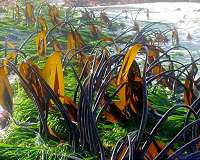
It's not just corals that are suffering as the world's oceans are reshaped by climate change and other harmful human activities — a study published Tuesday in the journal Global Change Biology shows marine seagrass meadows are also in decline.
According to a recent survey of marine carbon stocks in Western Australia's Cockburn Sound, the region lost nearly nine square miles of seagrass between the 1960s and 1990s as a result of nutrient runoff caused by coastal development.
Seagrass meadows help store large amounts of carbon. They also provide habitat for important marine species and protect coasts from flooding and erosion.
"Known as 'Blue Carbon,' seagrass meadows have been estimated to store CO2 in their soils about 30 times faster than most terrestrial forests," lead researcher Cristian Salinas said in a news release. "Seagrass meadows have been under constant threat in Australia through coastal development and nutrient run off since the 1960s."
"On top of that, climate change is causing marine heatwaves that are catastrophic to the seagrasses," said Salinas, a doctoral student at the Edith Cowan University in Western Australia. "This study serves as a stark reminder of how important these environments are."
Salinas and his colleagues suggest efforts to preserve and restore seagrasses could help boost Australia's carbon storage abilities.
For the new study, scientists designed models to understand how water depth, hydrodynamic energy, soil accumulation rates and soil grain size influence declines in carbon storage in the wake of seagrass meadow losses.
The simulations showed declines in seagrass alone don't explain carbon storage losses. Instead, hydrodynamic energy from waves, tides and currents all play a role in accelerating carbon storage losses.
"Without seagrass acting as a buffer, the hydrodynamic energy from the ocean releases the carbon by moving the seabed sand around," Salinas said.
In shallower areas free of seagrass, scientists measured faster water speeds and lower amounts of carbon storage. In shallow areas with seagrass meadows, researchers measured larger amounts of sequestered carbon.
"This means that nearshore meadows are particularly important to preserve," Salinas said.
