
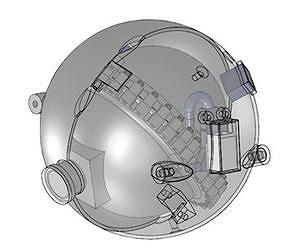
Small, spherical robots with a camera could someday navigate the underground pipes of a nuclear reactor to check for corrosion or leaks, U.S. researchers say.
Researchers at the Massachusetts Institute of Technology said a recent study found three-quarters of U.S. nuclear reactor sites have leaked radioactive tritium from buried piping that transports water to cool reactor vessels, often contaminating groundwater.
Identifying corrosion in a reactor's underground pipes is a major challenge for safety inspectors, who can only use indirect methods such as ultrasonic screening.
Now MIT engineering Professor Harry Asada and his colleagues are working on a direct monitoring alternative: small, egg-sized robots designed to dive into nuclear reactors and swim through underground pipes, checking for signs of corrosion.
The smooth robots have no external propeller or rudder, relying instead on small ports that expel water under pressure to guide and steer them.
A robot outfitted with external thrusters or propellers would easily lodge in a reactor's intricate structures, Asada said.
"You would have to shut down the plant just to get the robot out," Asada says. "So we had to make [our design] extremely fail-safe."
An on-board camera will capture images of the pipe's interior as it navigates the cooling system, the researchers said.
