
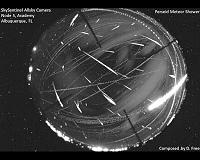
New imagery reveals what the Perseids looked like from all over the world. Student scientists created a composite of streaking meteors, building a global map of the meteor shower.
The SkySentinel project features a global network of wide-angle cameras pointed skyward. During the recent peak of the Perseid meteor shower, the cameras captured hundreds of shooting stars.
The SkySentinel project is managed by students at the Florida Institute of Technology. Currently, there are 58 SkySentinel Allsky cameras positioned in the United States and Canada. A few dozen more are located in India, Taiwan, Mexico and Brazil.
All of the cameras are constantly recording astronomical data and uploading it to a server at Florida Tech's Geospace Physics Lab, allowing researchers to go back an study events they missed or couldn't see from their position on Earth.
The 2016 Perseid meteor shower was one of the most active in several years, as a large section of debris left by Comet Swift-Tuttle was pulled into Earth's path by Jupiter's gravity.
