
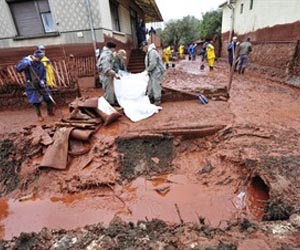
On October 4, 2010, following the burst of a containment structure operated by an alumina plant in Ajka, Hungary, about 700,000 m3 of highly caustic red mud slurry flooded three settlements and about 40 km2 of agricultural area along the Torna stream and the Marcal river (Supporting Information Figure SI 1). The spill caused the death of 10 persons (some of whom drowned and some who suffered severe burns from the alkaline solution) and major damage to property in the affected area.
This catastrophic industrial accident has been unprecedented in the 120-year-long history of the Bayer process.Red mud is a byproduct of the production of alumina from bauxite in the Bayer process which involves reaction with NaOH at high temperature and pressure.
The disposal of red mud raises severe environmental concerns, primarily because of its large volume and highly caustic nature.(1) Even though several schemes have been developed for the practical utilization of red mud, including its use for adsorption of metals from water,(2) the retention of phosphorus in soil,(3) and for CO2 sequestration,(4) most of the caustic sludge is stored in land-based deposits.(5)One of the environmental concerns related to red mud is the fact that its fine-grained particles can be released into the atmosphere by wind action.
Therefore, the technology of wet storage of red mud prescribes precautionary measures against drying and resuspension, including the recycling and regeneration of the caustic slurry above deposited red mud in containment structures, and covering and recultivation of filled-up disposal sites.
Although the properties and environmental "compatibility" of red mud have been studied extensively,(6, 7) the accident at the Ajka alumina plant presents a situation in which conditions significantly differ from those that were present in previous studies.
Since vast amounts of caustic red mud cover residential and agricultural areas, it is no longer possible to prevent drying and resuspension of particles by conventional technology. Outside of its technological storage facilities, massive resuspension of red mud particles may occur, posing unspecified health hazards in the area for a prolonged time. Among all potential mid- to long-term environmental problems, the emission of respirable particulate matter is of primary concern.
The health hazards posed by the respirable fraction of urban particulate matter have been the subject of numerous studies worldwide.(8) However, these results cannot be used directly to assess the adverse health effects of PM10 (respirable particulate matter with aerodynamically equivalent particle diameter <10 m) resuspended from red mud because the released particles are likely highly caustic due to the presence of residual NaOH-a property that is unique in a globally acidic ambient atmosphere.
A recently issued Risk Assessment Report on solid NaOH (9) explicitly declares that its atmospheric emission either in gaseous or particulate form is impossible. Further concerns may include the potential presence of other toxic or harmful constituents enriched in the fugitive dust of red mud sediment, including ultrafine particles, needle-like mineral particles, and labile transition metals.
The few available studies on the environmental effects and properties of red mud did not indicate significant toxicity or adverse effects of red mud after neutralization,(6, 7) but none attempted to assess the health hazard posed by the inhalation of either caustic or neutralized red mud particles.
Soils contaminated with industrial chemicals often raise the issue of potential genotoxic effects.(10)The objective of our study was to comprehensively characterize both the spilled red mud sediment and particulate matter (PM10) resuspended from it with special emphasis on the potential health hazard posed by inhalation of these particles.
Besides providing information for local residents and authorities involved in cleanup operations, our results can be relevant for uncovered red mud storage sites worldwide from which fugitive dust is released. The contamination of soil by red mud and its toxicity for plants is discussed in a companion paper.
Share This Article With Planet Earth
