
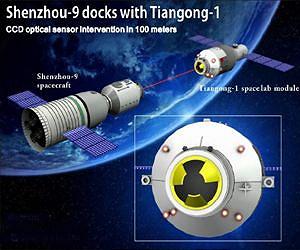
Tiangong 1 is described by its Chinese builders as a "space laboratory". This term is has been widely adopted by journalists and space analysts. It's probably not inaccurate to call the Tiangong 1 spacecraft, which has received its first crew of astronauts, a laboratory, for scientific experiments are certainly being conducted there. But does this term fully describe Tiangong 1?
Prior to the arrival of three astronauts on board the Shenzhou 9 spacecraft, it was difficult to say a lot about what was inside Tiangong. We had some basic information, some photographs and some rather dubious graphical illustrations to serve as guides.
We also had notice that crewed expeditions to the module would be few and would be short. This all served to reinforce the notion that Tiangong 1 could be thought of as a laboratory in space, and little else.
It was easy to invoke comparisons with Europe's "Spacelab" module, a cylindrical habitat that was sometimes flown in the payload bay of the US Space Shuttle.
Spacelab contained racks of laboratory equipment, space for astronauts in a central corridor, some basic atmospheric and thermal control systems, and little else. Astronauts worked aboard the module but did not really live there.
The necessities of life in space were still provided by facilities in the crew cabin of the Space Shuttle, which was connected to Spacelab by a tunnel. It could also not operate or fly independently of the Shuttle. Spacelab was certainly a laboratory, but it could not be called a space station.
Tiangong 1 would host crews delivered aboard Shenzhou spacecraft, which themselves carry all the basic essentials for life in space. It was theorized by this writer (and other analysts) that Tiangong would not duplicate all of the facilities found on board Shenzhou. This was partially due to the small volume of the Tiangong spacecraft and the proximity of Shenzhou. Some things did seem redundant, especially on short missions.
Gradually, we have learned more about the capabilities of Tiangong. Our first real images of its interior, presented before the first crew was launched, showed a module that looked far more inviting than the Spacelab of old.
The interior was very roomy and also featured two sleeping berths. Tiangong was starting to look a lot nicer to occupy. Images of the first crew to work on Tiangong have gradually revealed more about its features, and Chinese authorities have also disclosed more information. Tiangong also features toilet facilities, an independent communications system for the astronauts, exercise gear and provisions for the crew.
It seems more possible for astronauts to live aboard Tiangong without depending on their Shenzhou carrier spacecraft. This raises an interesting question. Is it really accurate to call Tiangong a space station?
Tiangong is small. Its logistical capabilities are also limited. It cannot support large crews. It will only host two brief expeditions. The work performed aboard Tiangong will be less than on many short-duration Shuttle missions. Yes, it's not a major home in space. But it still seems to qualify as a true space station.
Astronauts can live and work aboard Tiangong with facilities that are different (and in some cases more advanced) than those found aboard most other spacecraft, except for those that also qualify as space stations. It cannot return to Earth intact and does not support astronauts during launch. It also receives dockings from other spacecraft.
China seems to be reserving the term "space station" for the large, modular space station it plans to build around 2020. Calling Tiangong 1 a laboratory distinguishes this module from the next-generation space base in the future.
But Tiangong 1 still seems worthy of being called a small space station. Even if China persists with the Laboratory designator, analysts can still recognize its true status.
