
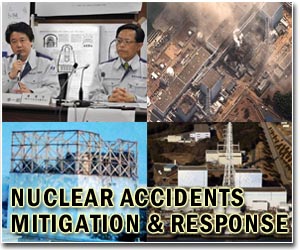
Japanese emergency teams are using fresh water instead of sea water to try to cool reactors at Japan's tsunami-damaged nuclear plant where meltdown is feared, the UN atomic watchdog said Saturday.
They had switched to using fresh water at the Fukushima nuclear power facility because it was less corrosive than sea water, the Vienna-based International Atomic Energy Agency said in a statement.
"The IAEA has been informed by Japanese authorities that fresh water is now being used in place of sea water to cool the reactor pressure vessels at units 1, 2 and 3 at the Fukushima nuclear plant," it said.
"The switch to fresh water is preferable as it leaves fewer deposits in components and is less corrosive than sea water."
Two weeks after the 9.0-magnitude March 11 quake and subsequent tsunami seriously damaged the ageing nuclear plant in northeastern Japan, rescue work is still under way to avoid a major nuclear disaster.
Radiation levels have surged in the seawater in the area and there are concerns that fuel rod vessels or their valves and pipes are leaking.
More than 27,000 people are dead or missing after the quake and tsunami.
earlier related report
Stricken Japan reactor marks 40th anniversary
Osaka (AFP) March 26, 2011 –
The Japanese operator of a stricken Fukushima nuclear plant Saturday marked 40 years since the first reactor started commercial operations with a boast of safety "unthinkable elsewhere".
"It is extremely disappointing to mark the 40th anniversary this way," Sakae Muto, vice-president of Tokyo Electric Power Co. (TEPCO), told a news conference. "And we feel very sorry."
The 9.0-magnitude quake and huge tsunami on March 11 paralysed the cooling systems of the Fukushima Daiichi (No.1) plant 250 kilometres (155 miles) northeast of Tokyo, leaving it on the brink of a catastrophic meltdown.
Emergency workers have sprayed huge amounts of water on the reactors — including the 460,000-watt number one reactor — to prevent the fuel rods becoming exposed and spewing out dangerous amounts of radiation.
US giant General Electric started construction of what was TEPCO's first nuclear reactor in September 1967. It began commercial operations on March 26, 1971.
Japan began nuclear power generation in 1963 at an experimental reactor in Tokai on the same coast, some 120 kilometres northeast of Tokyo. Now it has 55 nuclear reactors, accounting for 30 percent of electric power generation.
The Fukushima plant's commercial launch was celebrated as a milestone in Japan's drive into the age of nuclear energy.
"What is most important at a nuclear power plant is how safely nuclear energy is used," a narrator said in a public relations video. "Therefore, detailed care is paid to its safety in a way unthinkable elsewhere."
The 1977 Japanese-language video, which was entitled "The Nuclear Power of Fukushima" and updated in 1985, hailed the plant as a "model of technological innovation in nuclear power generation".
The film, available online at www.kagakueizo.org/2011/01/post-332.html, documents the construction of the plant on rocky foundations by the Pacific.
It shows work on a breakwater with 10,000 concrete blocks to protect the plant's port from "raging waves from the Pacific". But it was no match for the 14-metre (46-foot) tsunami and the plant is unlikely ever to be used again.
Share This Article With Planet Earth
