
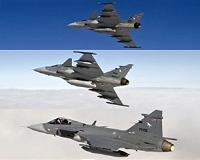
Swiss voters are set to sink a massive defence deal with Swedish firm Saab to buy 22 fighter planes, an opinion poll showed Friday ahead of a referendum next month.
The survey by the gfs.bern polling institute showed that 52 percent of voters opposed the plan, while 42 percent were in favour.
With just six percent of voters still to make up their minds, a turnaround by supporters of the fighter purchase appeared unlikely, the polling institute said.
Approved by the government in 2011 and backed by parliament last September, the fighter deal cannot be blocked as such in the May 18 referendum.
But opponents have been able to contest legislation that allowed the purchase to be funded by tapping an annual 300 million Swiss francs (246 million euros, $342 million) from the neutral country's military budget over 10 years.
The Swiss defence ministry has said that in the event the people reject the financing legislation, the decision will be respected, and that there is no back-up funding plan.
Switzerland opted for Saab's Gripen jets over the Rafale made by French company Dassault and the Eurofighter of pan-European firm EADS.
Supporters underline that in exchange for the sale, Saab and its engine supplier are contractually bound to sign business deals with Swiss firms worth 2.5 billion francs over the next decade.
Opponents dismiss that, and say that the 3.1-billion-franc price tag for the jets could end up tripling because of operating and maintenance costs as well as future upgrades.
The anti-deal coalition is steered by the left-leaning Socialists and Greens, plus anti-militarists who last year lost in a referendum in which voters bucked a European trend and kept their conscript army.
The Gripen's adversaries also include economic liberals opposed to the price.
Referendums form the cornerstone of Switzerland's system of direct democracy, and the campaigners forced a plebiscite by mustering more than 65,000 signatures from voters.
The Gripens are meant to replace Switzerland's three-decade-old fleet of 54 F-5 Tigers, built by US group Northrop.
The Swiss air force also has 32 F/A 18 Super Hornets built by US company McDonnell Douglas, purchased in 1996.
The military notes that with a combined fleet of 54 Gripens and Super Hornets, Switzerland's fleet would lag far behind the 300 jets in service in the early 1990s.
Sikorsky tests structural strength of new helicopter
Stratford, Conn. (UPI) Apr 11, 2013 –
An initial series of tests to verify the structural strength of the new CH-53K Super Stallion helicopter have successfully been completed by Sikorsky Aircraft.
The tests, required by the U.S. Naval Air Systems, were conducted using a full-size, non-flying airframe called the Static Test Article.
"The Static Test Article will enable Sikorsky to replicate the many stresses, strains and aerodynamic forces the CH-53K helicopter will experience during all aspects of flight, whether the aircraft is empty, filled with cargo, or carrying up to 36,000 pounds of gear suspended beneath the aircraft by an external sling," said Mike Torok, Sikorsky's CH-53K program vice president.
"By placing incrementally heavier static loads on various parts of the airframe assembly — including those well beyond the airframe's analytical design strength — we can measure structural integrity, airworthiness and crash worthiness, and verify safety margins for all expected operational conditions," Torok said.
"The Static Test Article is composed of the cockpit, cabin, fuel sponsons, a transition section and the tail rotor pylon — all suspended off the ground by the shaft of the aircraft's main rotor gearbox. Surrounding support beams hold the numerous hydraulic cylinders that apply the flight and inertial loads to parts of the airframe assembly," Sikorsky said.
Component-representative weights that simulate the presence of the engines and landing gear are also part of the configuration.
Six tests have been performed to date and testing will continue for another two years, the company said.
The CH-53K is a heavy-lift aircraft with a cruise speed of 196 miles per hour and a combat radius of 110 miles. The U.S. Marine Corps plans to procure some 200 CH-53Ks, which are expected to become operational in 2018.
