
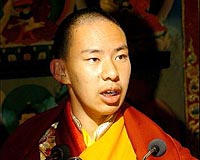
China's controversial choice as the second highest Tibetan spiritual leader has called on people in the Himalayan region to support the leadership of the communist party, state media said Sunday.
Gyaincain Norbu, the 11th Panchen Lama, said "the hard-earned happy life of today's Tibetans should be greatly cherished," the official Xinhua news agency reported.
His comments, to be published in Monday's People's Daily newspaper, the communist party mouthpiece, come after unrest erupted in an ethnically Tibetan town in China's northwestern Qinghai province on Saturday.
More than 90 monks were detained after they and other people attacked a police station in Rabgya, Lajia in Chinese, deep in the mountains of south Qinghai, according to Xinhua.
The protest was triggered by the escape of a man, Zhaxi Sangwu, from a police station on Saturday after he was detained and put under investigation Friday for "being involved in advocating 'Tibet independence'", Xinhua said.
Calm has now returned to Rabgya, Xinhua said, but a local resident told AFP there was a strong military presence in the town.
In his article, the Panchen Lama said Tibet "could only achieve today's prosperity and development as well as a more beautiful future under the CPC (communist party) leadership," Xinhua reported.
"All monks and nuns should uphold patriotism, abide by the law and commandments, and carefully study the essence of Buddhism," he said, according to Xinhua.
The article comes just under two weeks after the sensitive 50th anniversary of a failed uprising against Chinese rule in Tibet on March 10.
Chinese authorities have launched a massive security clampdown in recent weeks to quell possible unrest surrounding the anniversary of the uprising, which led the Dalai Lama, Tibet's spiritual leader, to flee into exile.
China's atheist government enthroned Gyaincain Norbu as the Panchen Lama in 1995, rejecting another boy selected by the exiled Dalai Lama in a move that defied long-held Buddhist traditions.
Exiled Tibetans have refused to accept the authority of the Panchen Lama and have expressed fears that he will be used by the government to select the next Dalai Lama.
China has ruled Tibet since 1951 after sending in troops to "liberate" the region the previous year.
Share This Article With Planet Earth
