
I think that the US Space Program needs very much to liberate itself from the heritage of the STS, first of all from SRB and from huge LOX/LH2 tanks. Dry mass of such tank of ARES 5, including 6 engines RS 68, amounts at least 65.000 kg and such dead mass will receive almost orbital velocity which constitutes a big loss of the fuel.
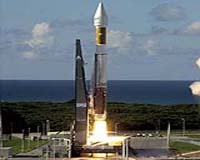
The Augustine Commission has outlined the most effective way from a long perspective point of view – an EELV- heritage Super-Heavy launcher based on 3-module Atlas 5 phase 2 Heavy. Each module of the first stage would consist from two RD180 engines and tank of 5 m in diameter.
In conjunction with common LOX/LH2 upper stage – probably 4x RL 10 engine – the launcher is likely to have LEO payload in range of 75 mt. Such launcher is capable to lift Altair and Orion /72 mt/ to LEO and still has margin of 3 mt. For Moon lending, it is necessary to use two additional 75 mt launchers to place EDS on LEO, preferably two-staged EDS.
The margin of such EDS would be in the extend enabling to execute, apart from TLI, also deceleration of the complex to LLO, or even to perform the main part of breaking during Altair landing on Moon surface/crash stage. Such possibilities would enable a substantial increase of the cargo curried by Altair to Moon. There is also a way to use in-space refueling of single-staged EDS.
It cannot be excluded that instead of two 75 mt launchers for EDS, one 5-module S.H. EELV launcher with J2X engine in second stage would be designed with LEO payload capacity in the range of 130 mt – more powerful that Saturn 5.
Consequently together with a 75 mt launcher, the system would have still higher capability than Ares 1 and Ares 5. For LEO operations of Orion – for example to ISS – core module itself and common second stage could be used with LEO payload capacity in the range of 30 to 35 mt.
S.H. EELV launchers would create a unified, modern and flexible space transport system with LEO capacities of 30 mt, 75 mt and 130 mt, suitable not only for deep space exploration but also for military scientific and even private activities in the near Earth space.
Development expenditures of the S.H. EELV launchers could be held in the acceptable range. All engines – RD180, RL10 or J2X – exist. Technical documentation of RD180 was handed out and could be taken as a base for development of a new LOX/RP domestic equivalent in the future.
Production line for 5 m dia tanks exist – Delta 4. All development, production, service of new launchers would be curried out by private firms, resulting in huge savings in NASA in case that relevant part of its employees is released or transferred.
Important parts of STS infrastructure – assembling hall and transporter could by used after some adjustment. Of course, such approach would be a revolution for NASA and its culture and a strong opposite from its side can be expected.
Share This Article With Planet Earth
