
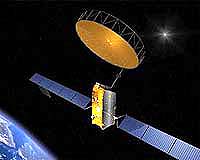
Inmarsat (has confirmed the successful launch and acquisition of the third Inmarsat-4 satellite. The satellite was launched on a Proton Breeze M rocket from the Baikonur Cosmodrome in Kazakhstan at 11:43pm BST on 18 August (4:43am 19th August, local time).
Inmarsat's tracking station in Fucino, Italy was able to track the satellite while it was still coupled to the Breeze M launch vehicle. Launch provider ILS confirmed successful spacecraft separation at 8:46am BST on 19 August.
The satellite is the third in the I-4 constellation, concluding a decade of development and a US$1.5 billion investment.
The current constellation of two Inmarsat-4 satellites delivers mobile broadband services to 85 per cent of the world's landmass, covering 98 per cent of the world's population. The third I-4 will complete the global coverage for Inmarsat's broadband services.
Global coverage
Andrew Sukawaty, chief executive and chairman of Inmarsat, said: "The Inmarsat-4s are the world's most sophisticated commercial network for mobile voice and data services, and the successful launch of the third I-4 allows us to complete the global coverage for our broadband services. Once the third I-4 is operational, Inmarsat will have the only fully-funded next-generation network for mobile satellite services."
"Congratulations to ILS on another successful Proton launch. The F3 launch has been highly anticipated. This satellite will enable Inmarsat to complete its BGAN services to subscribers across the globe," said Sukawaty. "We thank ILS for its due diligence in returning to flight successfully."
The Proton Breeze M is one of the few launch vehicles capable of lifting the I-4 satellite – the size of a London double-decker bus and weighing six tons – into geostationary transfer orbit.
The I-4 F3 satellite will now undergo a period of deployment and several weeks of comprehensive tests and manoeuvres before being positioned in geostationary orbit at 98 degrees West.
Inmarsat satellites are currently relied on by the world's shipping, oil exploration, defence and aviation industries to service their communications needs. Inmarsat is also the communications channel of choice for the media when reporting from the world's danger zones and for NGOs, government agencies and the United Nations when coordinating rescue efforts.
The Inmarsat-4 F3 satellite, a Eurostar 3000GM model built by EADS Astrium, is expected to go into service at 98 degrees West longitude, where it will deliver mobile broadband services over the United States for Inmarsat of London.
"This is a major milestone event for Inmarsat. ILS is proud to be a part of the construction of their global service with the successful Proton launch of Inmarsat-4 F3 today," said ILS President Frank McKenna.
